Free Support 24/7
011 208 1308

Free Support 24/7
011 208 1308

Ratings: ★★★★☆ (3.8/5)
Genre: Paranormal, Alternative History, Ancient Civilizations, Sri Lankan Studies, Egyptology
Book Review:
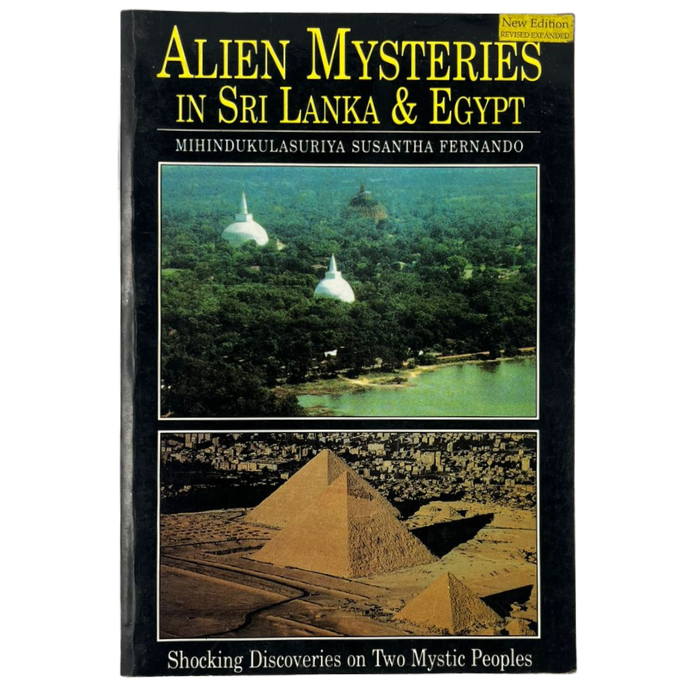
Mihindukulasuriya Susantha Fernando's ''Alien Mysteries in Sri Lanka & Egypt'' is a work that defies easy categorization. Part history, part speculation, part alternative archaeology, it proposes connections between two ancient civilizations that conventional scholarship has never considered—and suggests that the explanation may lie not in human history but in extraterrestrial intervention.
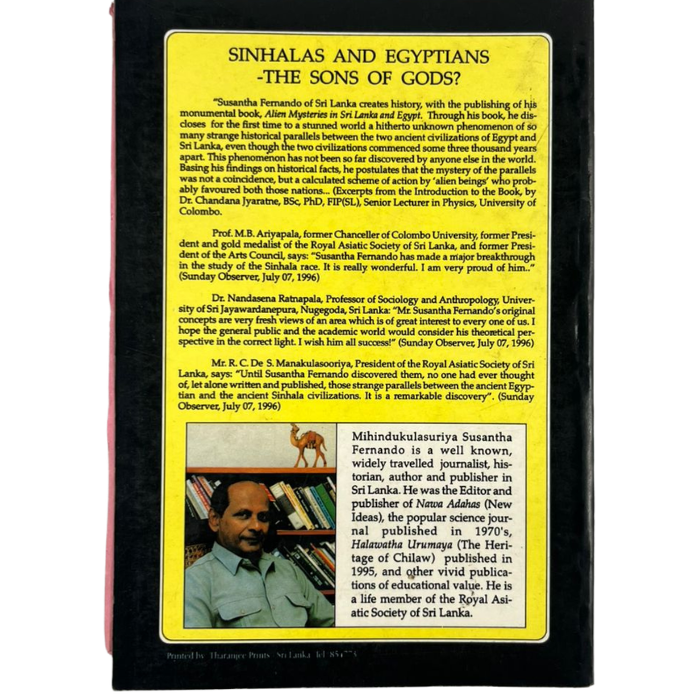
The book's central claim is striking: despite being separated by some three thousand years, Egyptian and Sinhala civilizations exhibit numerous ''strange historical parallels'' that cannot be explained by coincidence. Fernando, a journalist and historian with deep roots in Sri Lankan intellectual life (he edited the popular science journal ''Nawa Adahas'' in the 1970s and is a life member of the Royal Asiatic Society), has assembled evidence that, at minimum, invites curiosity.
What makes this work noteworthy is the response it has received from established scholars. Professor M.B. Ariyapala, former Chancellor of Colombo University and former President of the Royal Asiatic Society, describes it as ''a major breakthrough in the study of the Sinhala race'' and ''really wonderful.'' Professor Nandasena Ratnapala of the University of Sri Jayawardenepura praises its ''original concepts'' and ''very fresh views.'' R.C. De S. Manakulasooriya, President of the Royal Asiatic Society, confirms that ''no one had ever thought of, let alone written and published, those strange parallels'' before Fernando's discovery.
This scholarly endorsement from mainstream institutions gives the book a credibility unusual for works in the ''ancient aliens'' genre. Dr. Chandana Jayaratne's introduction—written by a Senior Lecturer in Physics at the University of Colombo—frames Fernando's findings within a serious intellectual context, even as he entertains the hypothesis of ''alien beings.''
Readers should approach this book with open but critical minds. Fernando is asking genuinely interesting questions about historical parallels that deserve investigation. Whether one accepts his extraterrestrial hypothesis or seeks alternative explanations, the parallels themselves may reward study. The book stands as a testament to the value of amateur scholarship—the willingness to see connections that specialists, constrained by disciplinary boundaries, might miss.
For readers interested in Sri Lankan history, Egyptology, alternative archaeology, or simply bold intellectual speculation, ''Alien Mysteries'' offers a provocative journey. It reminds us that history is not a closed book but an ongoing conversation, and that the most interesting questions are often those that established frameworks cannot answer.

182150-img.png)
