Free Support 24/7
011 208 1308

Free Support 24/7
011 208 1308

Ratings: ★★★★☆ (4.5/5)
Genre: Education / Sociology / Sri Lankan Non-fiction
Book Review:
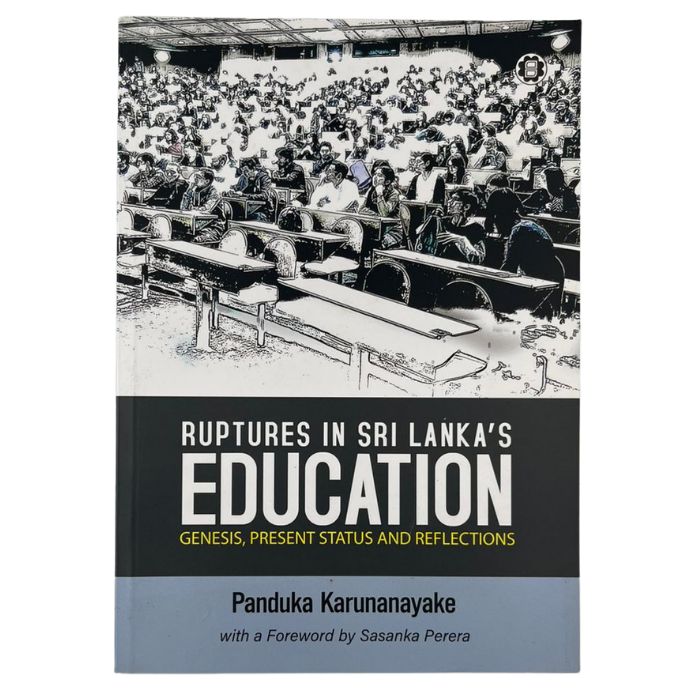
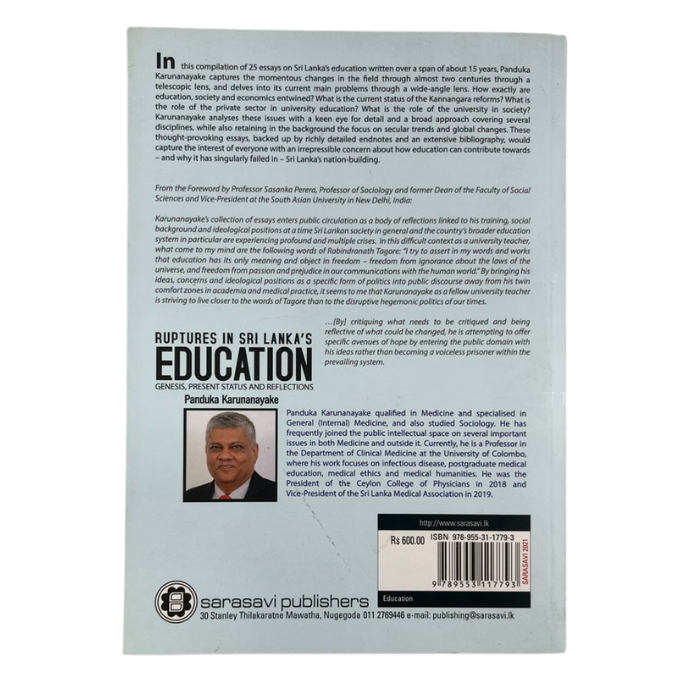
Panduka Karunanayake's ''Ruptures in Sri Lanka's Education'' is a rare and invaluable contribution to the public intellectual discourse on a topic that affects every citizen yet is seldom analyzed with such depth and breadth. As a physician and sociologist, Karunanayake brings a unique dual perspective to this collection of 25 essays, offering a diagnosis that is both clinically precise and socially aware.
The book's structure is metaphorically brilliant: it uses a telescopic lens to trace the grand arcs of educational change over nearly two centuries, from colonial influences to post-independence reforms, and then switches to a wide-angle lens to capture the sprawling, interconnected crises of the present. This approach allows the reader to see how historical ruptures have led to the current fragmented landscape.
What sets this work apart is its fearless interdisciplinary approach. Karunanayake doesn't confine himself to educational theory; he weaves in economics, sociology, and political science to answer pressing questions: What is the legacy of the Kannangara reforms today? How is the private sector reshaping higher education? What is the university's true purpose in a rapidly changing society?
Professor Sasanka Perera's foreword beautifully frames the book's significance, noting that Karunanayake steps out of his ''comfort zones in academia and medical practice'' to enter the public domain with his ideas, striving for the Tagorean ideal of education as a path to freedom—freedom from ignorance and from prejudice. The essays are not mere academic exercises; they are acts of public service, critiquing what needs to be changed and offering avenues of hope.
Backed by richly detailed endnotes and an extensive bibliography, this book is essential reading for educators, policymakers, students, and any concerned citizen who shares an ''irrepressible concern'' for Sri Lanka's future. It is a powerful reminder that education is never just about syllabi and exams—it is about the very fabric of our society and our nation-building project. Highly recommended.

195515-img.png)