Free Support 24/7
011 208 1308
Free Support 24/7
011 208 1308


Ratings: ★★★★☆ (4.2/5)
Genre: Literary Fiction, Philosophical Fiction, Fantasy, Magical Realism
Book Review:
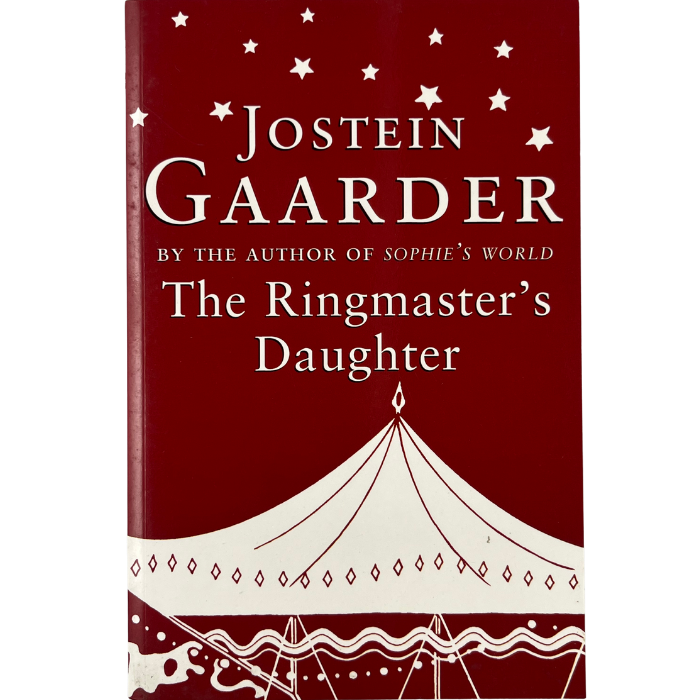
Jostein Gaarder became an international phenomenon with ''Sophie's World,'' his novel that introduced millions of readers to the history of philosophy through the eyes of a curious teenager. In ''The Ringmaster's Daughter,'' Gaarder returns to familiar terrain—the borderlands between reality and imagination, the power of stories, and the mysteries of identity—but with a darker, more complex vision.
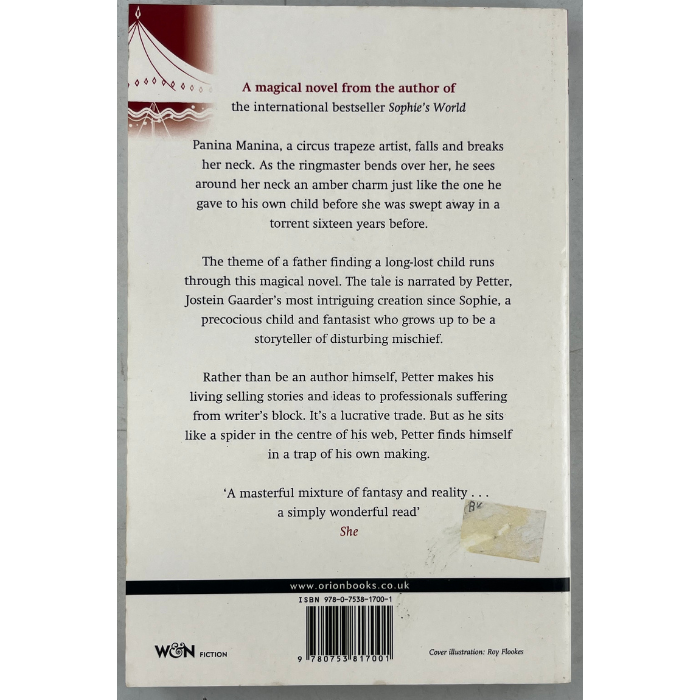
The novel begins with a death. Panina Manina, a circus trapeze artist, falls and breaks her neck. As the ringmaster bends over her, he sees an amber charm around her neck—a charm identical to the one he gave his own daughter sixteen years earlier, before she was swept away in a flood. Is this dying woman his long-lost child? The question haunts the novel, but Gaarder is too sophisticated a writer to offer simple answers.
The story is narrated by Petter, a character who ranks among Gaarder's most fascinating creations. As a child, Petter is precocious and imaginative, living in a world of fantasy. As he grows up, he becomes a storyteller—but not in the usual sense. Rather than write stories himself, he sells ideas and plots to professional writers suffering from creative block. It's a strange and lucrative trade. Petter sits like a spider at the center of a vast web, feeding stories to those who need them, invisible and indispensable.
But Petter's web becomes a trap. The more stories he tells, the more entangled he becomes in the lives of others—and in his own past. The novel weaves together multiple narratives: the circus tragedy, Petter's childhood, his relationships with the writers he serves, and the mystery of the ringmaster's daughter. Gradually, these threads converge in surprising and unsettling ways.
Gaarder's prose is elegant and accessible, translated with sensitivity from the original Norwegian. He has a gift for making philosophical ideas feel immediate and personal, woven into the fabric of character and plot. The novel asks profound questions: What is the relationship between stories and truth? Between imagination and identity? Can we ever truly know who we are—or who we've lost?
The circus setting is beautifully evoked—a world of glitter and danger, of performance and authenticity. The ringmaster, the trapeze artist, the other performers—they become metaphors for the roles we all play, the masks we all wear.
If ''Sophie's World'' was Gaarder's playful introduction to philosophy, ''The Ringmaster's Daughter'' is his darker, more mature meditation on the same themes. It's a novel about loss and longing, about the stories we tell to make sense of our lives, and about the price we pay for living in imagination.
As She magazine wrote, this is ''a masterful mixture of fantasy and reality... a simply wonderful read.'' For fans of Gaarder, and for anyone who loves novels that make you think while they move you, ''The Ringmaster's Daughter'' is highly recommended.