Free Support 24/7
011 208 1308

Free Support 24/7
011 208 1308

Ratings: ★★★★☆ (3.8/5)
Genre: Literary Fiction, Romance, War Fiction, Classic
Book Review:
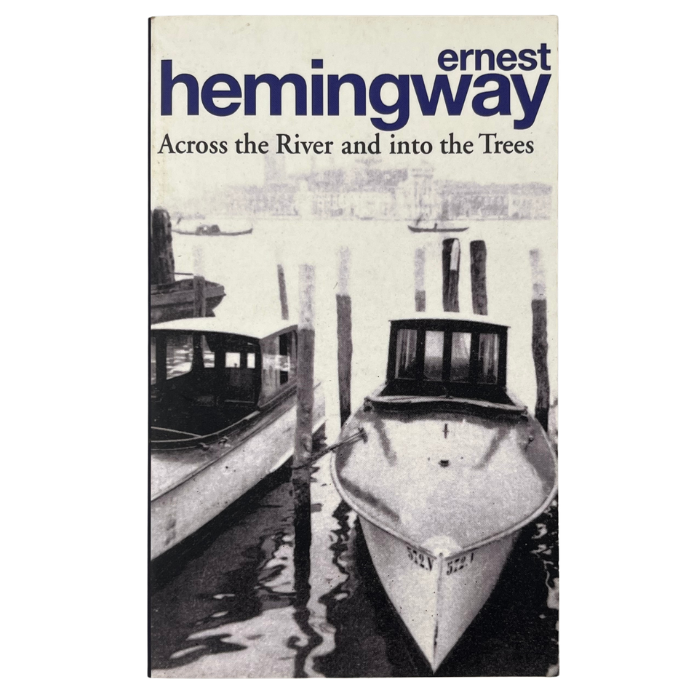
Ernest Hemingway's ''Across the River and into the Trees'' is a novel that divides critics and readers. Published in 1950, after a decade-long silence, it was savaged by some reviewers and praised by others. Today, it's generally considered a minor work in the Hemingway canon—flawed but fascinating, a book that reveals the author's obsessions and vulnerabilities more nakedly than his masterpieces.
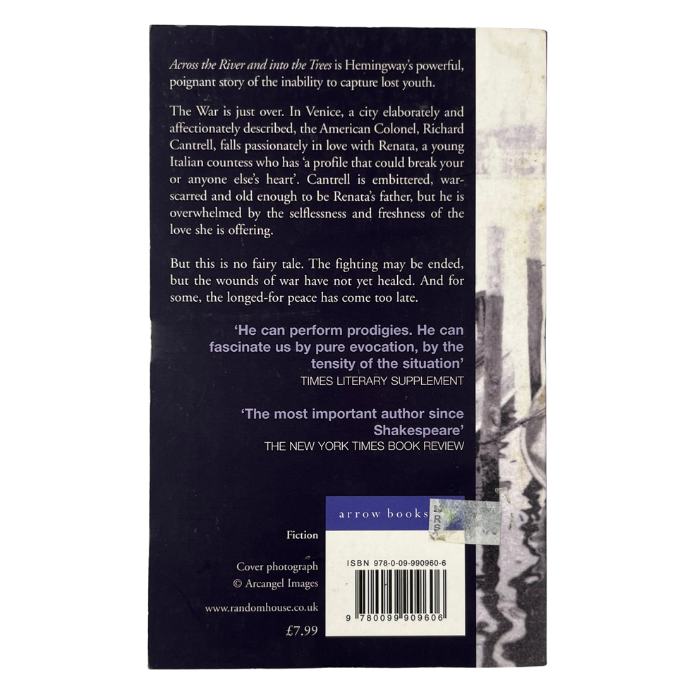
The novel follows Colonel Richard Cantrell, an American officer approaching fifty, who has come to Venice for a duck-hunting trip. He's a war hero, scarred by combat and by life. He's also dying—of hypertension, we learn, though the novel is more interested in his spiritual state than his physical condition. In Venice, he meets Renata, a young Italian countess of breathtaking beauty. They fall in love.
What follows is a series of conversations, memories, and reflections as Cantrell and Renata explore Venice together. He tells her about the war, about the men he's lost, about the things he's done. She listens, offers him her youth and her love, tries to heal wounds that may be beyond healing. Their relationship is intense, tender, and doomed.
The novel is rich with Hemingway's characteristic strengths: the precise, evocative descriptions of place (Venice comes alive in these pages), the spare dialogue that reveals more than it says, the sense of men living under the shadow of death. The duck-hunting scenes are among the best Hemingway ever wrote—patient, detailed, almost meditative.
But the novel also has significant weaknesses. Cantrell can be insufferably self-romanticizing, and some readers find the relationship with Renata unconvincing. The dialogue sometimes veers into parody of Hemingway's style. And the novel's structure is loose, almost rambling.
The critical response at the time was mixed. The Times Literary Supplement praised Hemingway's ability to ''perform prodigies... fascinate us by pure evocation, by the intensity of the situation.'' The New York Times Book Review, in a famously hyperbolic phrase, called him ''the most important author since Shakespeare.'' But other reviewers were harsh, and the novel was widely seen as a disappointment after ''For Whom the Bell Tolls.''
Today, ''Across the River and into the Trees'' is best approached as a late-career curiosity—a novel that reveals Hemingway wrestling with themes of age, love, and mortality in ways that would culminate in ''The Old Man and the Sea.'' For Hemingway completists, it's essential reading. For newcomers, it's not the place to start—but for those already familiar with his work, it offers a poignant glimpse into the author's later years.
Recommended for dedicated Hemingway fans. Others may want to start with ''The Sun Also Rises'' or ''A Farewell to Arms.''