Free Support 24/7
011 208 1308

Free Support 24/7
011 208 1308

Ratings: ★★★★☆ (4.4/5)
Genre: Short Stories, Literary Fiction, Postcolonial Literature, Magical Realism
Book Review:
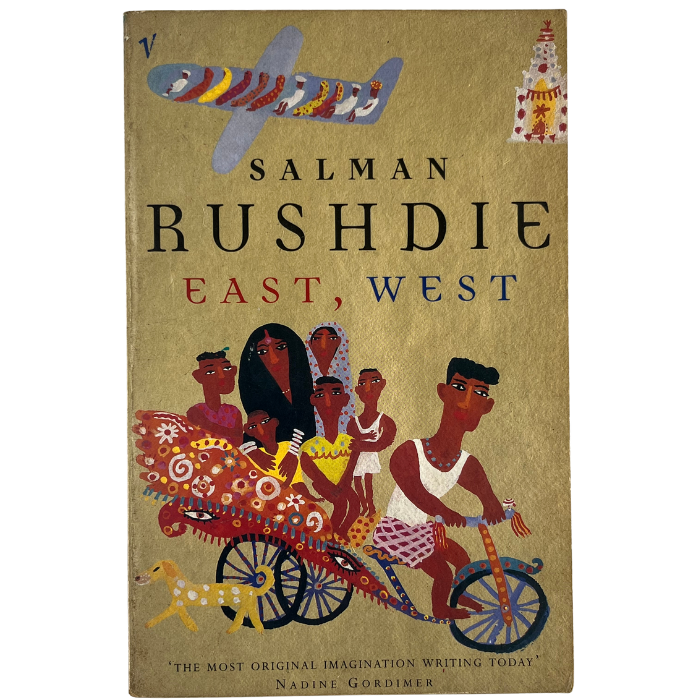
Salman Rushdie is justly celebrated for his novels—the sprawling, magical, politically charged epics that have made him one of the most important writers of our time. But ''East, West'' reminds us that he is also a master of the short story form. This collection, published in 1994, brings together nine stories that showcase Rushdie's extraordinary range, his wit, his humanity, and his unerring instinct for the telling detail.
The collection is elegantly structured in three sections. The first, ''East,'' contains three stories set in India, exploring themes of tradition, family, and the collision between old and new. ''The Free Radio'' tells the story of a young rickshaw driver seduced by the promise of free radios—a seemingly simple tale that becomes a meditation on desire, deception, and the stories we tell ourselves. ''The Prophet's Hair'' is a classic Rushdie conceit—a sacred relic goes missing in Srinagar, setting off a chain of events that blends the sacred and the profane, the comic and the tragic, in characteristic fashion.
The second section, ''West,'' moves to England, exploring the immigrant experience with humor and pathos. ''At the Auction of the Ruby Slippers'' is a dazzling piece of speculative fiction, imagining a world where the iconic shoes from The Wizard of Oz are up for auction, and the bidders are driven by their deepest desires. It's a brilliant meditation on nostalgia, celebrity, and the commodification of dreams. ''Christopher Columbus and Queen Isabella of Spain Consummate Their Relationship'' is exactly what it sounds like—a hilarious, irreverent, surprisingly tender exploration of history, power, and love.
But it's the final section, ''East, West,'' where Rushdie truly shines. These three stories explicitly grapple with the hybrid identities that emerge from the meeting of cultures. ''The Harmony of the Spheres'' follows an Indian writer in London whose friendship with an Englishman obsessed with the occult leads to tragedy. ''Chekov and Zulu'' uses Star Trek as a lens through which to explore the relationship between two Indian diplomats—a brilliant conceit that allows Rushdie to probe questions of identity, loyalty, and the masks we wear. And the final story, ''The Courter,'' is perhaps the finest in the collection—a moving, funny, deeply human tale of an Indian family in London, their ayah (nanny), and the mysterious ''courter'' who comes to call. It's a story about love, loss, and the small acts of kindness that sustain us.
Throughout these stories, Rushdie's prose is, as always, a delight. He writes sentences you want to read aloud, full of music and surprise. His characters are vivid and particular, even in the brief space a story allows. And his themes—home and exile, memory and desire, the stories we inherit and the stories we create—resonate across cultures and continents.
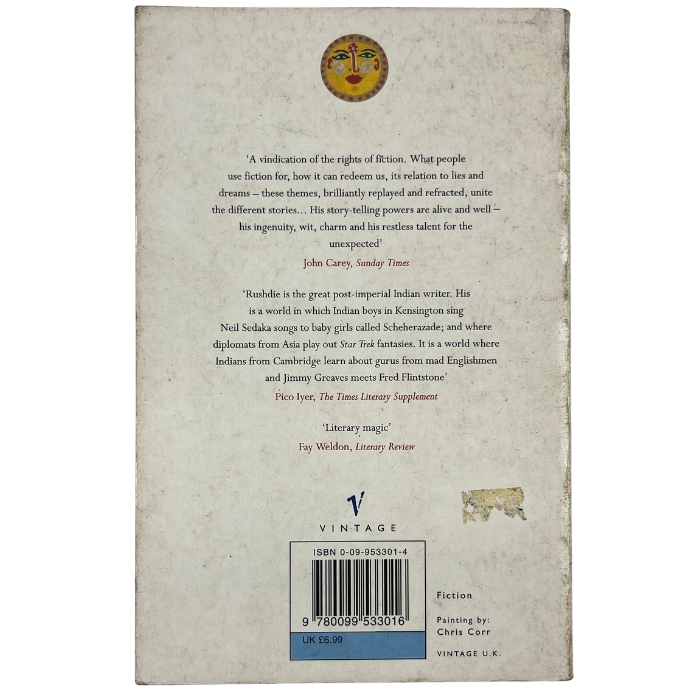
As John Carey wrote in The Sunday Times, ''His story-telling powers are alive and well—his ingenuity, wit, charm and his restless talent for the unexpected.'' Pico Iyer, in The Times Literary Supplement, captured Rushdie's achievement perfectly: ''His is a world in which Indian boys in Kensington sing Neil Sedaka songs to baby girls called Scheherazade; and where diplomats from Asia play out Star Trek fantasies.''
''East, West'' is a wonderful introduction to Rushdie's work for new readers, and a treasure for those already familiar with his novels. It's a collection that will make you laugh, think, and feel—often on the same page. Highly recommended.