Free Support 24/7
011 208 1308

Free Support 24/7
011 208 1308


Ratings: ★★★★☆ (4.5/5)
Genre: Biography, Sri Lankan History, Colonial History, Political History
Book Review:
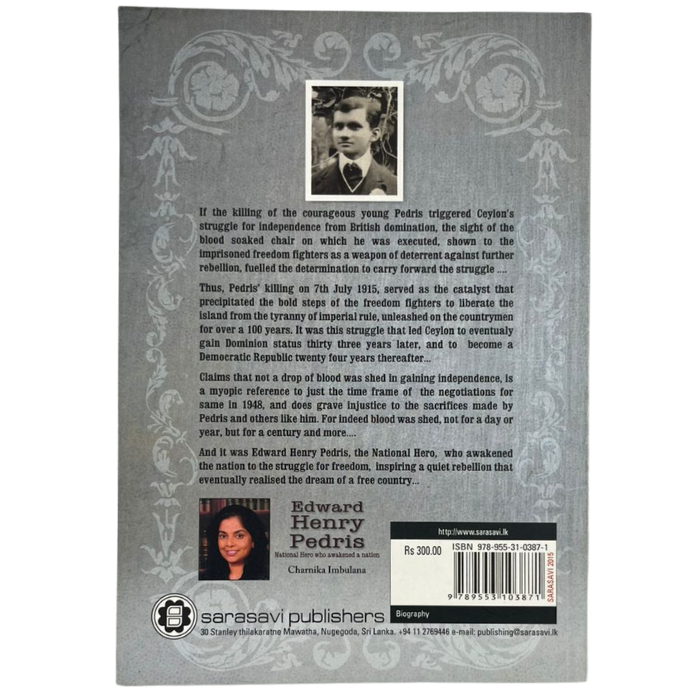
Charnika Imbulana's ''Edward Henry Pedris'' performs an essential act of historical recovery, restoring to public memory a figure whose sacrifice helped awaken Sri Lanka's independence movement but who has since been largely forgotten. The book's subtitle—''National Hero who awakened a nation''—asserts Pedris's significance, and Imbulana's meticulous research provides compelling evidence for this claim.
Pedris's story is both tragic and inspiring. A young man of courage and conviction, he was executed by British colonial authorities on July 7, 1915, following the communal riots of that year. His death was intended as a deterrent—an example to others who might resist colonial rule. The blood-soaked chair on which he was killed was shown to imprisoned freedom fighters as a warning of the consequences of rebellion.
But the strategy backfired. Rather than suppressing resistance, Pedris's martyrdom fuelled it. Imbulana argues persuasively that his killing ''served as the catalyst that precipitated the bold steps of the freedom fighters to liberate the island from the tyranny of imperial rule.'' The sight of that chair, meant to intimidate, instead ''fuelled the determination to carry forward the struggle.''
The book's larger argument challenges a persistent myth in Sri Lankan historical consciousness—the claim that ''not a drop of blood was shed in gaining independence.'' Imbulana exposes this as ''a myopic reference to just the time frame of the negotiations for same in 1948,'' doing ''grave injustice to the sacrifices made by Pedris and others like him.'' Blood was indeed shed, she insists, ''not for a day or year, but for a century and more.''
This reframing of independence history is crucial. It reminds us that freedom was not simply granted through negotiations but won through generations of resistance, sacrifice, and struggle. Pedris stands in this larger tradition—one of many whose contributions have been obscured by narratives focused on the final negotiations.
The biography draws on historical records to reconstruct Pedris's life and times, placing him within the broader context of anti-colonial resistance in early twentieth-century Ceylon. Imbulana writes with passion for her subject while maintaining scholarly rigor, producing a work that serves both as memorial and as historical analysis.
For readers interested in Sri Lankan history, anti-colonial movements, or simply the story of a remarkable life cut short in the service of freedom, this book is essential. It ensures that Edward Henry Pedris takes his rightful place among the national heroes who awakened a nation and inspired the long struggle for independence.