Free Support 24/7
011 208 1308

Free Support 24/7
011 208 1308

Ratings: ★★★★☆ (4.5/5)
Genre: Cultural Criticism / Literary Criticism / Sri Lankan Non-fiction
Book Review:
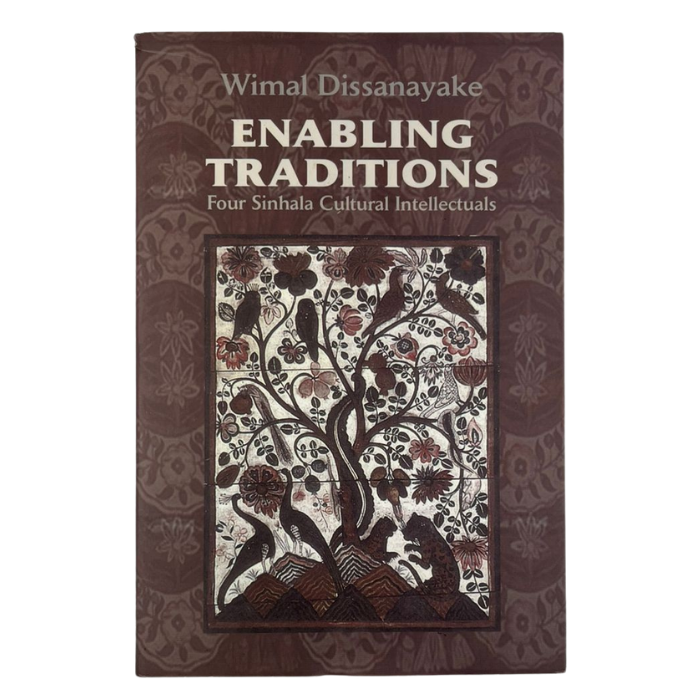
Professor Wimal Dissanayake's ''Enabling Traditions'' is a luminous work of cultural criticism that deserves a place on the bookshelf of anyone interested in the intellectual history of modern Sri Lanka. With clarity and depth, Dissanayake examines the lives and works of four towering figures in Sinhala cultural life—Munidasa Cumaratunga, Martin Wickramasinghe, Ediriweera Sarachchandra, and Gunadasa Amarasekera—and in doing so, illuminates the central tension that has shaped Sri Lankan modernity: the relationship between tradition and innovation.
Each of these figures represents a different facet of this tension. Cumaratunga, the language reformer and poet, sought to revitalize Sinhala by returning to its classical roots while simultaneously pushing it toward new expressive possibilities. Wickramasinghe, the novelist and thinker, explored the psychological and social dimensions of a society in transition, creating characters caught between village and city, past and future. Sarachchandra, the playwright and scholar, reinvented Sinhala drama by drawing on traditional folk forms like the Kolam and Sokari while engaging with modern theatrical movements from the West. Amarasekera, the physician-turned-writer, brought a psychoanalytic sensibility to his explorations of desire, family, and social change.
What makes Dissanayake's approach so valuable is his theoretical sophistication. He doesn't simply summarize their work; he analyzes it through the lens of contemporary debates about culture, history, language, and human agency. He shows how each of these intellectuals ''enabled'' tradition—not by preserving it in amber, but by reinterpreting it, reimagining it, and putting it in dialogue with the modern world. Tradition, in their hands, becomes a living resource rather than a dead weight.
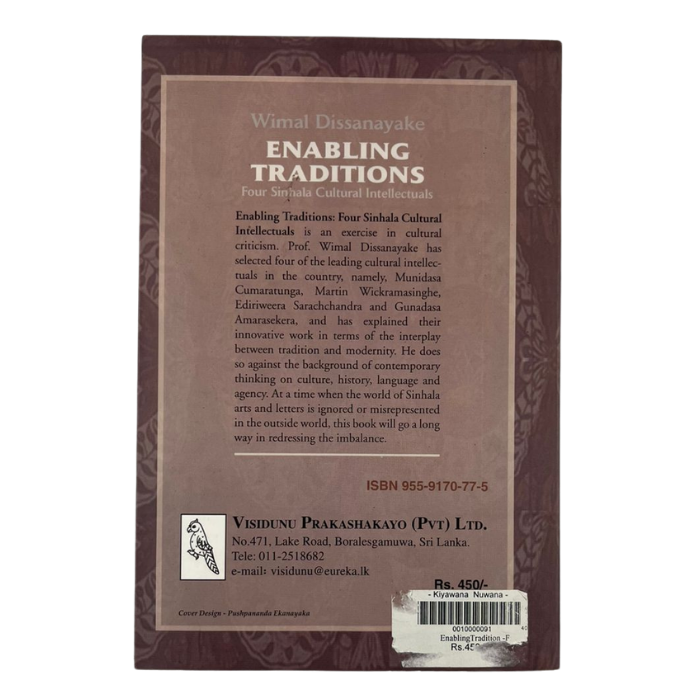
The book is also timely. As Dissanayake notes in his introduction, Sinhala arts and letters are too often ignored or misrepresented in global discourse. This book helps correct that imbalance, demonstrating the richness and complexity of Sri Lankan intellectual life to an international audience. It is a work of recovery and celebration, but also of rigorous analysis.
The prose is accessible without being simplistic, scholarly without being ponderous. Dissanayake wears his learning lightly, guiding the reader through complex ideas with a steady hand. The book is beautifully produced by Visidunu Prakashakayo, a publisher known for its commitment to serious Sri Lankan scholarship.
For students of Sri Lankan culture, this book is indispensable. For general readers interested in how societies navigate the tensions between tradition and modernity, it offers a fascinating case study. And for anyone who believes that the global conversation about culture should include voices from outside the usual centers of power, ''Enabling Traditions'' is a welcome and enriching contribution. Highly recommended.