Free Support 24/7
011 208 1308

Free Support 24/7
011 208 1308

Ratings: ★★★★☆(4.5/5)
Genre: History / Sri Lankan Studies / Cultural Studies
Book Review:
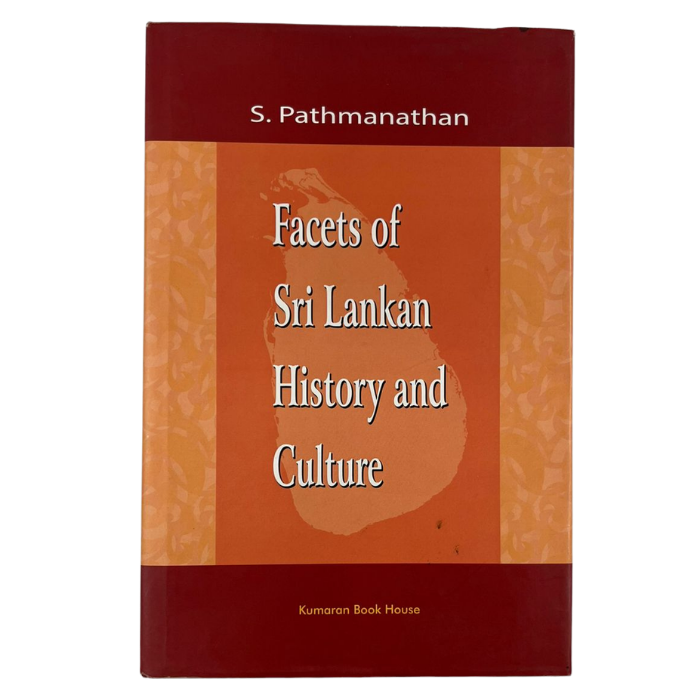
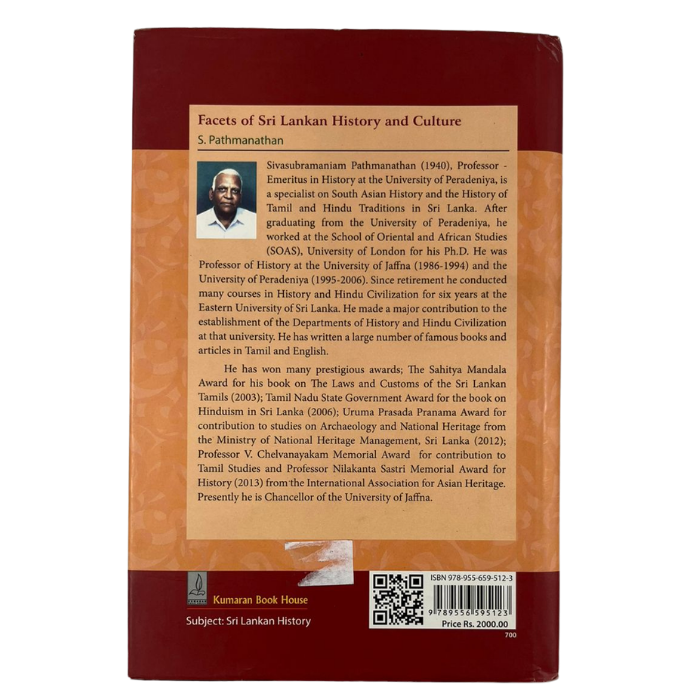
Professor S. Pathmanathan's ''Facets of Sri Lankan History and Culture'' is a distinguished contribution to the scholarly literature on Sri Lanka, offering readers a rich and nuanced exploration of the island's complex past and cultural heritage. As Professor-Emeritus in History at the University of Peradeniya and a specialist in South Asian history with particular expertise in Tamil and Hindu traditions, Pathmanathan brings decades of research and teaching experience to this work.
The book's title aptly captures its approach: rather than attempting a single, linear narrative, Pathmanathan examines multiple ''facets'' of Sri Lankan history and culture, allowing readers to appreciate the diversity and complexity of the island's heritage. This approach is particularly valuable in the Sri Lankan context, where history has often been politicized and simplified. Pathmanathan's nuanced treatment resists such simplifications, presenting a more complex and accurate picture.
The author's credentials are impeccable. After graduating from the University of Peradeniya, he earned his Ph.D. from the School of Oriental and African Studies (SOAS) at the University of London. He served as Professor of History at the University of Jaffna (1986-1994) and the University of Peradeniya (1995-2006), and after retirement continued teaching at the Eastern University of Sri Lanka, where he helped establish the Departments of History and Hindu Civilization. His numerous publications in Tamil and English have earned him prestigious awards, including the Sahitya Mandala Award, the Tamil Nadu State Government Award, and the Professor V. Chelvanayakam Memorial Award. He currently serves as Chancellor of the University of Jaffna.
This book reflects the breadth of Pathmanathan's expertise. It covers topics ranging from ancient and medieval Sri Lankan history to the development of Tamil and Hindu traditions, from legal and social customs to archaeological and national heritage. The writing is scholarly but accessible, making it suitable for both academic readers and general readers with a serious interest in Sri Lanka.
For students of Sri Lankan history, this book is an essential resource. For scholars in related fields—South Asian studies, cultural studies, religious studies—it offers valuable comparative perspectives. And for anyone seeking to understand the deep roots of Sri Lanka's contemporary challenges and possibilities, ''Facets of Sri Lankan History and Culture'' provides the historical grounding necessary for informed reflection.
Published by Kumaran Book House, this volume is a testament to the ongoing vitality of Sri Lankan scholarship. It deserves a place in every serious library of Sri Lankan studies. Highly recommended.

182150-img.png)