Free Support 24/7
011 208 1308

Free Support 24/7
011 208 1308

Ratings: ★★★★★ (5/5)
Genre: Biography / History / Indian Studies
Book Review:
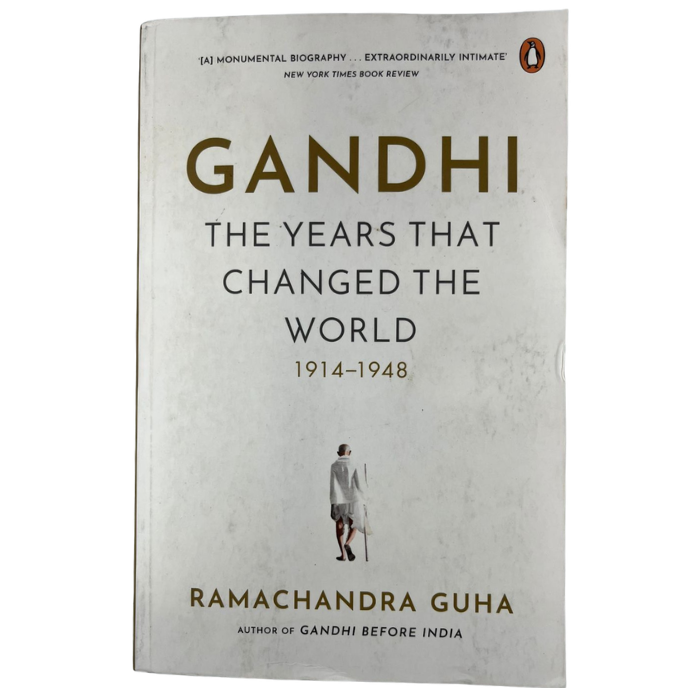
Ramachandra Guha's ''Gandhi: The Years That Changed the World'' is a monumental achievement—the second and concluding volume of a biography that will surely stand as the definitive account of Mahatma Gandhi's life for generations. Following the acclaimed ''Gandhi Before India,'' this volume covers the three decades from Gandhi's return to India in 1914 to his assassination in 1948, the period in which he became the Mahatma and transformed the Indian independence movement.
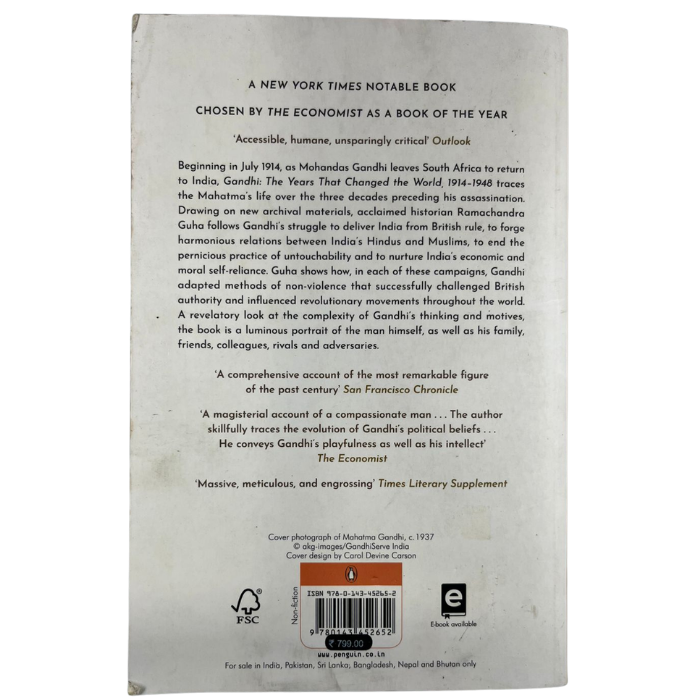
The critical reception has been extraordinary. The New York Times Book Review calls it ''a monumental biography... extraordinarily intimate.'' The Economist names it a Book of the Year, praising it as ''a magisterial account of a compassionate man'' that ''skillfully traces the evolution of Gandhi's political beliefs'' and ''conveys Gandhi's playfulness as well as his intellect.'' The Times Literary Supplement describes it as ''massive, meticulous, and engrossing.'' Outlook, in India, praises it as ''accessible, humane, unsparingly critical.''
Guha, one of India's most distinguished historians, brings unparalleled credentials to this task. He has spent decades researching Gandhi's life and legacy, and this volume draws on new archival materials that shed fresh light on familiar episodes. But the book is more than a political history; it is also a deeply human portrait. Guha shows us Gandhi the man—his relationships with family, friends, colleagues, rivals, and adversaries. He captures Gandhi's complexity, his contradictions, his evolution.
The book covers the major campaigns of Gandhi's Indian years: the Champaran satyagraha, the Non-Cooperation Movement, the Salt March, the Quit India Movement. It examines his efforts to bridge Hindu-Muslim divisions and to end the practice of untouchability. It explores his economic thinking and his vision for India's future. And it does not shy away from his failures and limitations.
But the book is also filled with smaller, intimate moments that bring Gandhi to life. We see him with his wife Kasturba, with his disciples, with his opponents. We see his humor, his warmth, his occasional impatience. Guha resists the temptation to create a saint; his Gandhi is fully human.
For anyone interested in Gandhi, this book is essential. For students of Indian history, it is a masterwork. For general readers, it is a compelling narrative about one of the most remarkable figures of the modern age. Guha has given us a gift: a biography worthy of its subject. Highly recommended.

183931-img.png)