Free Support 24/7
011 208 1308


1 ×LKR 1,000.00

1 ×LKR 1,500.00

1 ×LKR 800.00

1 ×LKR 800.00
Free Support 24/7
011 208 1308

Ratings: ★★★★☆ (4.5/5)
Genre: Buddhist Studies / Religious History / Sri Lankan Studies
Book Review:
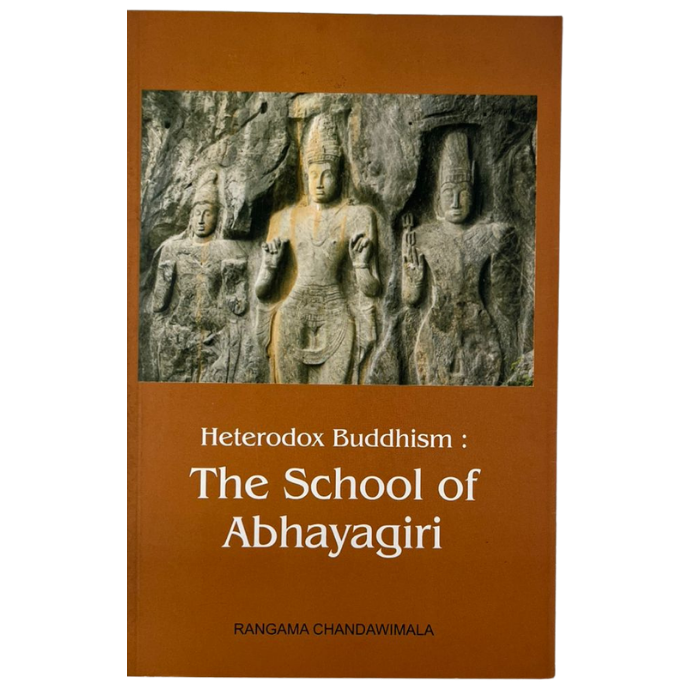
Rangama Chandawimala's ''Heterodox Buddhism: The School of Abhayagiri'' is a significant contribution to the scholarly literature on Sri Lankan Buddhist history, offering a detailed examination of one of the island's most important but often misunderstood monastic traditions.
The Abhayagiri Fraternity was, for centuries, a major center of Buddhist learning and practice in ancient Sri Lanka. Unlike its rival, the Mahavihara, Abhayagiri was open to influences from other Buddhist traditions, including Mahayana and Vajrayana. This openness made it ''heterodox'' from the perspective of the Mahavihara, which championed a more orthodox Theravada. Chandawimala's book explores what this meant in practice: what teachings were adopted, how they were integrated, and what impact they had on the development of Buddhism in Sri Lanka.
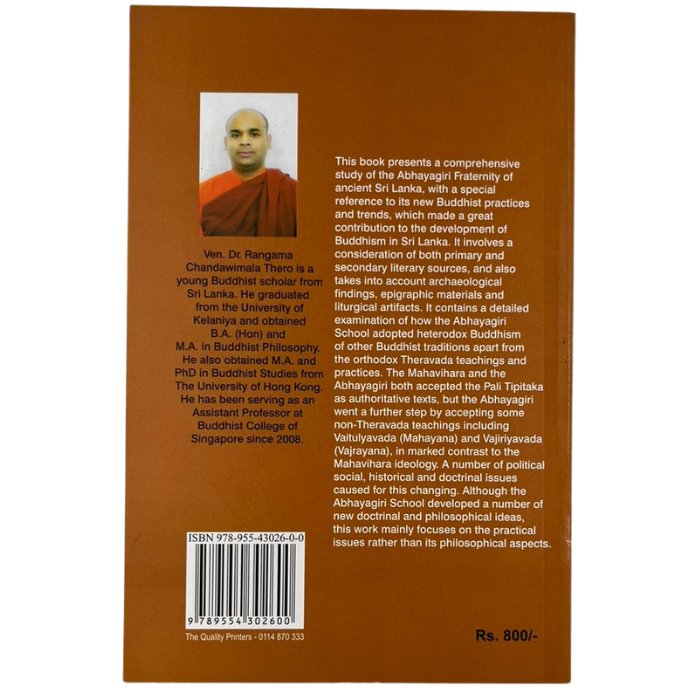
The author brings strong credentials to this task. A young Sri Lankan scholar, he graduated from the University of Kelaniya with a BA (Hons) and MA in Buddhist Philosophy, then earned MA and PhD degrees in Buddhist Studies from the University of Hong Kong. Since 2008, he has served as an Assistant Professor at the Buddhist College of Singapore. This combination of local knowledge and international training serves him well.
The book draws on a wide range of sources: primary and secondary literary texts, archaeological findings, epigraphic materials, and liturgical artifacts. Chandawimala considers how political, social, historical, and doctrinal factors contributed to the development of Abhayagiri's distinctive character. While the Abhayagiri School developed new doctrinal and philosophical ideas, this work focuses mainly on practical issues—how these ideas were actually implemented in the life of the monastic community.
For students of Buddhist history, this book is essential reading. It fills a gap in the literature, providing a comprehensive account of a tradition that has often been neglected in favor of the Mahavihara. For scholars of Sri Lankan history, it offers insight into the religious diversity that characterized the island in ancient times. And for anyone interested in how Buddhism adapted to different contexts, it provides a fascinating case study.
The book is published in Sri Lanka at a reasonable price (Rs. 800), making it accessible to local readers. The quality of production is adequate for a scholarly work.