Free Support 24/7
011 208 1308

Free Support 24/7
011 208 1308

Ratings: ★★★★☆ (4.4/5)
Genre: Theology, Christian Studies, Liberation Theology, Sri Lankan Religious Thought
Book Review:
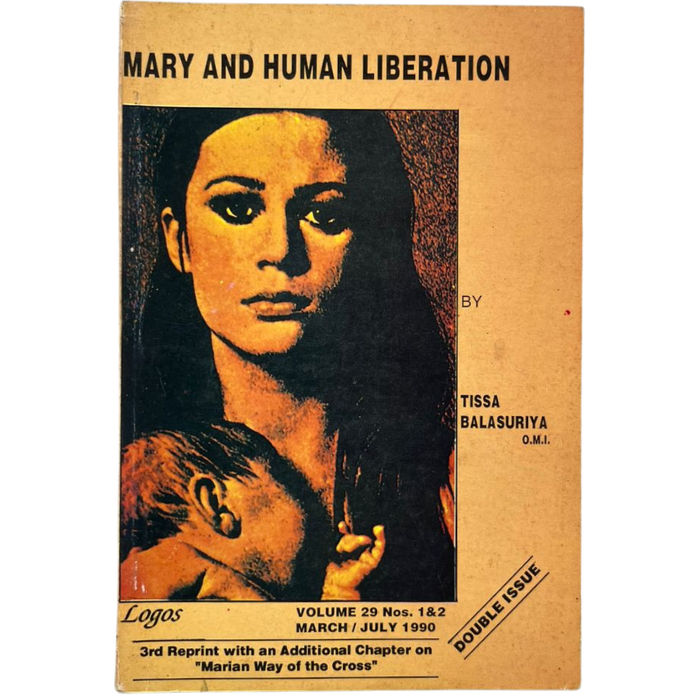
Fr. Tissa Balasuriya's ''Mary and Human Liberation'' represents a significant contribution to the development of contextual theology in Sri Lanka. As one of the island's most prominent and sometimes controversial theological voices, Balasuriya brings his characteristic intellectual courage to the task of reinterpreting traditional Marian doctrine through the lens of liberation.
The book's approach is both faithful and innovative. Balasuriya does not reject traditional understandings of Mary but asks what they might mean when read from the perspective of the poor and oppressed. If Mary's Magnificat proclaims that God ''has brought down the powerful from their thrones and lifted up the lowly,'' then authentic Marian theology cannot ignore questions of social justice. This connection between religious symbol and political reality is the book's central contribution.
The additional chapter on the ''Marian Way of the Cross'' deepens this analysis, connecting Mary's suffering at the foot of the cross to the sufferings of ordinary people in contemporary Sri Lanka. Balasuriya's ability to move between biblical text, theological tradition, and lived experience gives his work a concreteness often missing in more abstract theological writing.
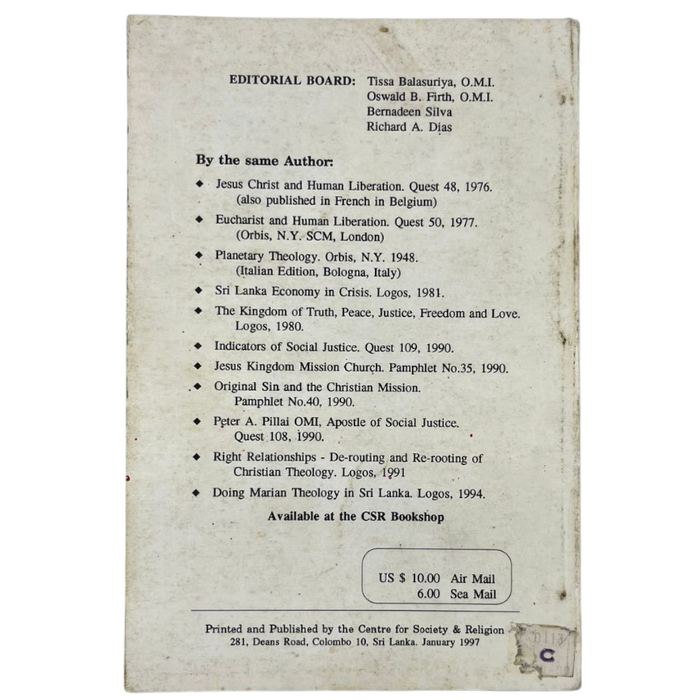
Balasuriya's broader theological project—evident in his other works like ''Jesus Christ and Human Liberation,'' ''Eucharist and Human Liberation,'' and ''Planetary Theology''—seeks to develop a theology adequate to the challenges of our time: poverty, injustice, ecological crisis, inter-religious conflict. ''Mary and Human Liberation'' fits within this larger vision, demonstrating that even the most traditional elements of Christian faith can speak to contemporary struggles when interpreted with courage and creativity.
Published by the Centre for Society & Religion in Colombo, a institution Balasuriya helped establish, this work reflects a commitment to theology that engages with social reality rather than escaping from it. The Centre's location in Colombo, at the heart of Sri Lankan urban life, symbolizes this engagement.
For readers interested in Asian theology, liberation theology, or simply fresh approaches to traditional religious questions, ''Mary and Human Liberation'' offers valuable insights. It demonstrates that theology need not be either faithful to tradition or responsive to contemporary concerns—it can be both. Balasuriya's Mary is not a distant heavenly figure but a presence alongside those who struggle for justice and dignity, a model of faithful resistance to oppression.