Free Support 24/7
011 208 1308

Free Support 24/7
011 208 1308


Ratings: ★★★★☆ (4.5/5)
Genre: Gender Studies / Sociology / Cultural Theory
Book Review:
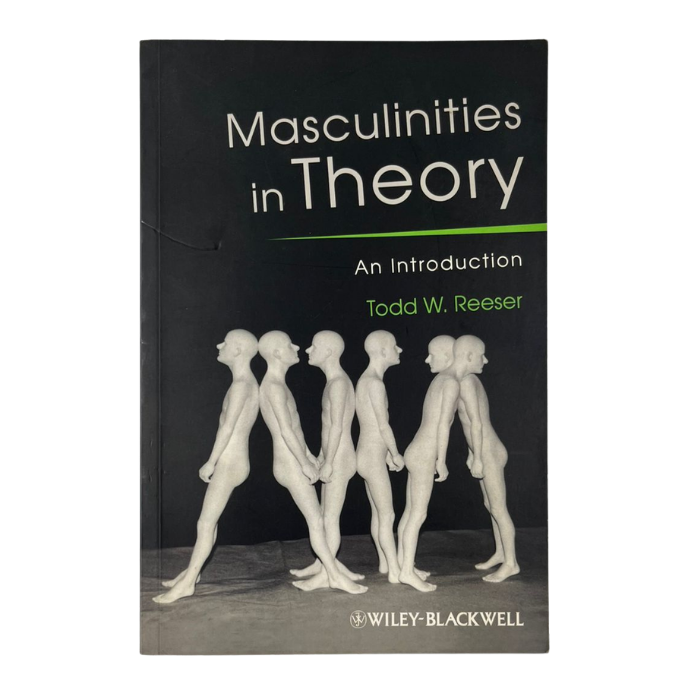
Todd W. Reeser's ''Masculinities in Theory'' fills a crucial gap in the literature of gender studies. While feminist theory and queer theory have long had accessible introductions, masculinity studies—despite its growth as a field—has lacked a comprehensive, clear, and theoretically sophisticated overview. Reeser's book remedies this situation brilliantly.
The book's central question—''What is masculinity and how does it work?''—is deceptively simple. As Reeser demonstrates, masculinity is anything but simple. It is multiple, unstable, performative, and deeply entangled with other categories of identity and power: race, class, sexuality, nation, and history. Reeser guides the reader through these complexities with a steady hand, introducing key theoretical concepts while always keeping them grounded in concrete examples.
One of the book's great strengths is its interdisciplinary range. Reeser draws on literature, film, art, and cultural studies, showing how masculinity is constructed and contested across different media and contexts. He engages with a wide array of theorists—from Judith Butler and Michel Foucault to Pierre Bourdieu and R.W. Connell—explaining their ideas clearly while also pointing out their limitations and the debates they have generated.
The structure of the book is pedagogical without being simplistic. Each chapter focuses on a key theoretical approach or concept: the relation of masculinity to feminism, psychoanalysis, the social sciences, post-structuralism, and post-colonialism. Later chapters explore specific topics like the male body, masculinity and nation, and transgender masculinities. Throughout, Reeser balances exposition with critical analysis, encouraging readers to think for themselves rather than simply accepting received wisdom.
The endorsements from leading scholars are well-deserved. Lewis Seifert calls it ''the most comprehensive overview of masculinity studies available,'' while Jeffrey Peters praises its ''nuanced discussion'' of key theoretical concepts. David LaGuardia notes how Reeser skillfully describes masculinity as ''an inherently multiple and unstable concept, ideology, and practice.''
For students encountering masculinity studies for the first time, this book is an ideal starting point. It assumes no prior knowledge but never talks down to its readers. For scholars already working in the field, it offers a valuable synthesis of current debates and a stimulus to further thinking. And for anyone interested in how gender shapes our lives and our world, ''Masculinities in Theory'' provides the tools to understand one of the most powerful yet often invisible forces in contemporary culture.
Reeser has given us a book that is both an introduction and a contribution—a work that will guide newcomers into the field while also advancing scholarly conversations. It belongs on the bookshelf of every serious student of gender studies. Highly recommended.



151542-img.png)