Free Support 24/7
011 208 1308

Free Support 24/7
011 208 1308

Ratings: ★★★★★ (5/5)
Genre: Law / Family Law / Customary Law / Gender Studies / Sri Lankan Legal Literature
Book Review:
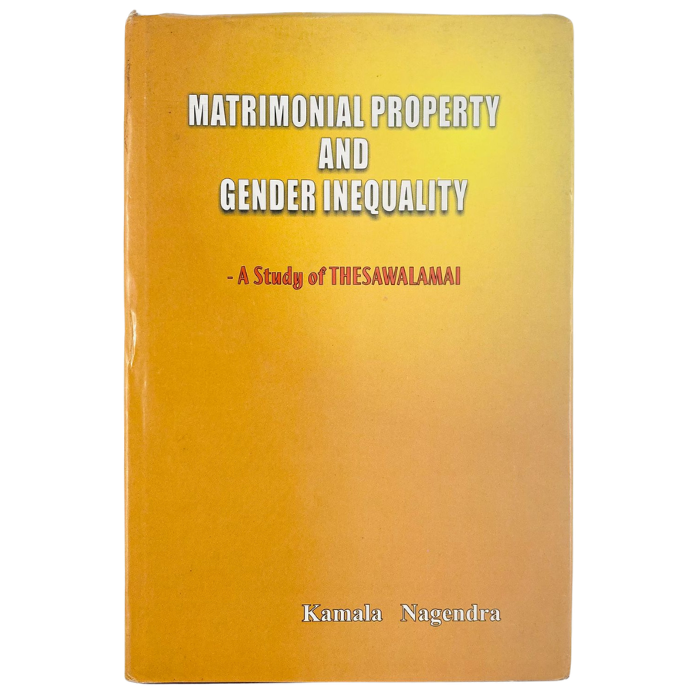
Kamala Nagendra's Matrimonial Property and Gender Inequality: A Study of Thesawalamai is a landmark contribution to Sri Lankan legal scholarship. This meticulously researched work examines Thesawalamai—the customary law governing the Tamil population of the Jaffna Peninsula—through the critical lens of gender equality and property rights.
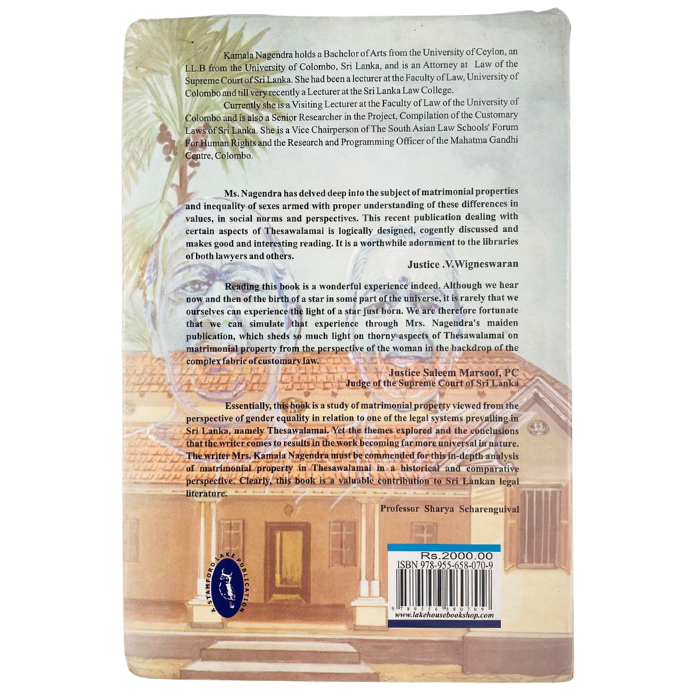
Nagendra brings exceptional credentials to this study. A former lecturer at the Faculty of Law, University of Colombo, and Sri Lanka Law College, she currently serves as a Senior Researcher in the Compilation of Customary Laws of Sri Lanka project. This deep engagement with customary law is evident throughout the book, which combines historical analysis, legal doctrine, and gender theory to illuminate how Thesawalamai's provisions on matrimonial property have historically disadvantaged women.
The book is structured to provide readers with a comprehensive understanding of the subject. Nagendra traces the origins and evolution of Thesawalamai, examines its core principles regarding ownership and inheritance of matrimonial property, and analyzes how these principles operate in practice. She does not simply describe the law but subjects it to critical scrutiny, asking whether its provisions align with constitutional guarantees of equality or perpetuate gender-based discrimination.
What makes this work particularly valuable is its grounding in both legal scholarship and lived experience. The author's understanding of the social norms and perspectives that shape Thesawalamai practice adds depth to the legal analysis. Justice Saleem Marsoof, PC, notes in his foreword that reading this book is ''a wonderful experience,'' while Professor Sharya Scharenguival describes it as ''a valuable contribution to Sri Lankan legal literature.''
For legal practitioners, scholars of family law, students of gender studies, and anyone interested in Sri Lanka's plural legal system, this book is essential reading. Highly recommended.