Free Support 24/7
011 208 1308

Free Support 24/7
011 208 1308

Ratings: ★★★★☆ (4.4/5)
Genre: Literary Fiction, Autobiographical Fiction, Family Saga, Sri Lankan Literature
Book Review:
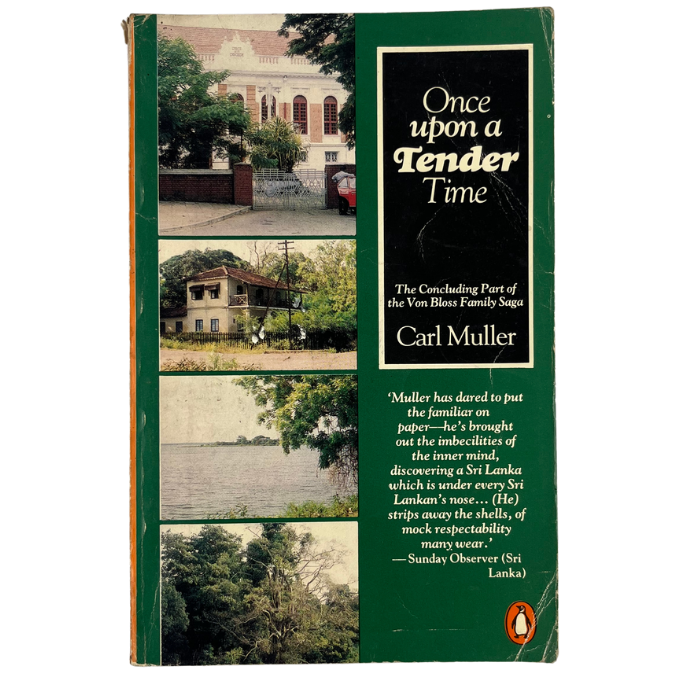
Carl Muller's Burgher trilogy has been a landmark in Sri Lankan English literature, and ''Once Upon a Tender Time'' brings it to a close in fitting style. This concluding volume is a poignant, hilarious, and deeply affectionate memoir of childhood—a book that captures the essence of growing up in Sri Lanka's Burgher community with warmth and unflinching honesty.
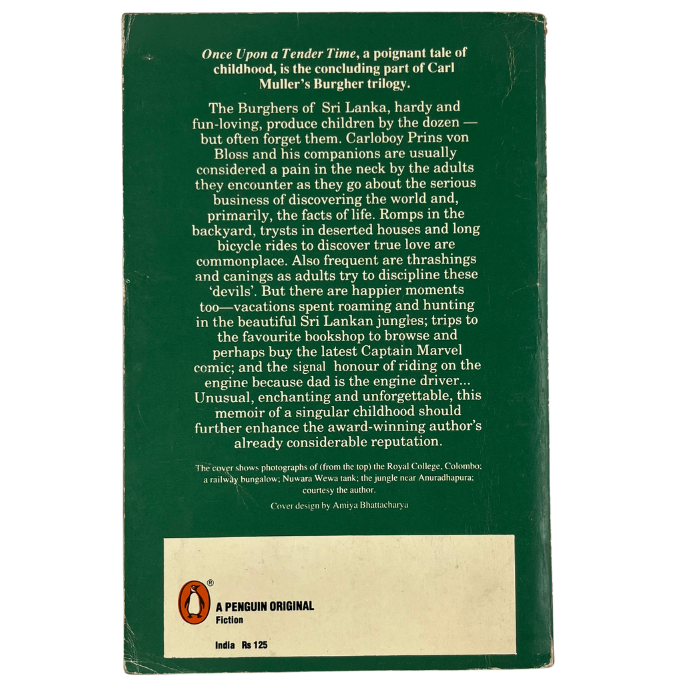
The novel follows Carloboy Prins von Bloss, a character readers will recognize from earlier books, and his companions as they navigate the world of childhood. It's a world of discovery: backyard romps, secret meetings in deserted houses, long bicycle rides in search of true love, and the constant struggle to understand the baffling behavior of adults.
Muller's prose is as lively and irreverent as ever. He captures the cadences of Burgher speech, the rhythms of family life, the chaos of a household full of children. The dialogue crackles with energy, and the set pieces—the thrashings, the adventures, the moments of unexpected tenderness—are rendered with cinematic vividness.
But the novel is more than just a collection of amusing anecdotes. It's also a meditation on memory, on the way childhood shapes us, on the bittersweet passage of time. The adults in the story—parents, grandparents, aunts and uncles—are drawn with equal care. They're not just obstacles to the children's fun; they're complex human beings with their own dreams, frustrations, and regrets.
The Sri Lankan setting is beautifully evoked. Muller captures the landscape—the jungles, the tanks, the railway lines—with a lover's eye. The trips to the bookshop, the hunting expeditions, the rides on the train engine: these moments are not just nostalgia; they're a record of a world that has largely vanished.
The Sunday Observer (Sri Lanka) praises Muller's courage in ''putting the familiar on paper'' and ''stripping away the shells of mock respectability many wear.'' That's exactly right. Muller writes about his community with love, but also with honesty. He shows the flaws, the absurdities, the moments of cruelty and kindness that make up any family's history.
For readers who have followed the von Bloss saga from the beginning, ''Once Upon a Tender Time'' is a satisfying conclusion—a chance to revisit beloved characters and see how their stories end. For new readers, it works as a standalone memoir, a window into a world that is both specific and universal.
As the cover notes, this is ''unusual, enchanting and unforgettable.'' It's a book that will make you laugh, make you cry, and make you grateful for the tender times of your own childhood.
Highly recommended for anyone interested in Sri Lankan literature, in family sagas, or simply in beautifully written memoirs.