Free Support 24/7
011 208 1308

Free Support 24/7
011 208 1308

Ratings: ★★★★★ (5/5)
Genre: Poetry / Indian Literature / Classics
Book Review:
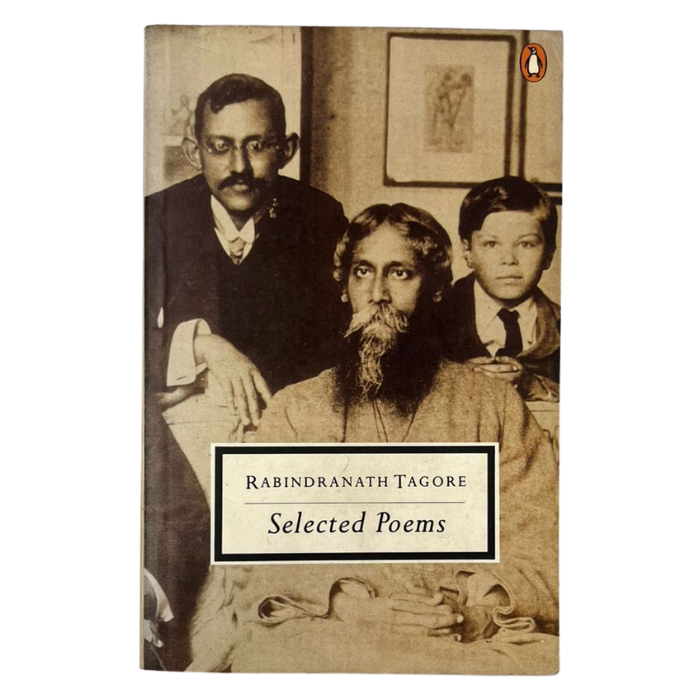
Rabindranath Tagore is one of those rare figures who transcends categorization. Poet, novelist, dramatist, musician, painter, philosopher, educator, nationalist—he was all of these and more. In 1913, he became the first non-European to win the Nobel Prize in Literature, and his work has been beloved in his native Bengal and around the world ever since. This Penguin edition of ''Selected Poems,'' translated by William Radice, offers an excellent introduction to his poetic achievement.
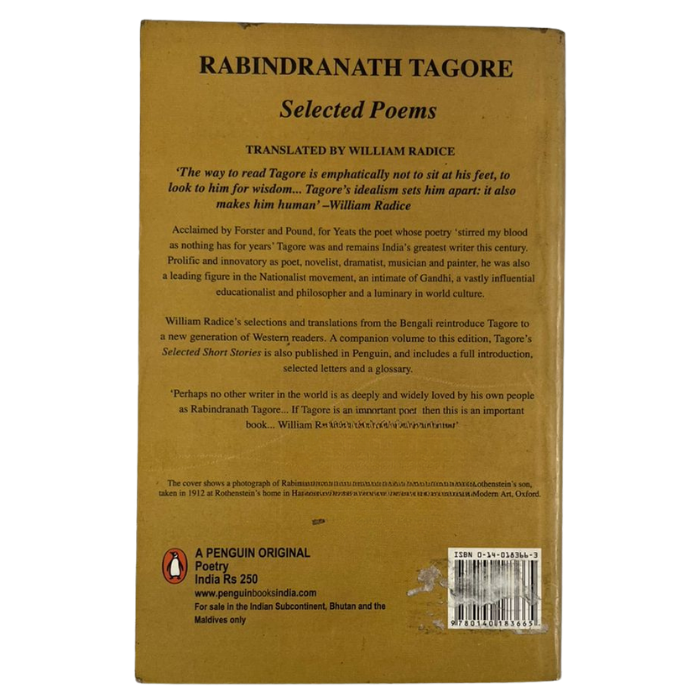
The endorsements on the cover speak to Tagore's stature. W.B. Yeats, who helped introduce Tagore to the West, wrote that his poetry ''stirred my blood as nothing has for years.'' E.M. Forster and Ezra Pound were also admirers. And yet, as translator William Radice notes, ''The way to read Tagore is emphatically not to sit at his feet, to look to him for wisdom.'' Tagore is not a guru dispensing eternal truths; he is a poet, a human being, and his work is best approached as poetry rather than philosophy.
Radice's translations are a significant achievement. Translating poetry is notoriously difficult, and Tagore's Bengali is particularly challenging—lyrical, musical, deeply rooted in a specific cultural and linguistic tradition. Radice captures both the sense and the spirit of the originals, producing English poems that stand on their own while remaining faithful to Tagore's voice.
The selection covers the full range of Tagore's poetic career, from his early works through his later, more experimental phase. Readers will encounter the lyricism of ''Gitanjali'' (Song Offerings), the work that won him the Nobel, as well as poems that show his engagement with politics, nature, love, and mortality. The variety is impressive, and the quality is consistently high.
For readers new to Tagore, this volume is the perfect starting point. Radice's introduction provides helpful context without overwhelming the poems themselves. For those already familiar with Tagore, these translations offer fresh perspectives on familiar works. And for anyone who loves poetry, this book is a treasure.
The Penguin edition is well-produced, with a cover photograph showing Tagore reading his poems. It's a handsome volume that will grace any bookshelf.
''Perhaps no other writer in the world is as deeply and widely loved by his own people as Rabindranath Tagore,'' the back cover notes. This collection helps explain why. Tagore's poetry speaks across cultures and generations, touching something universal in human experience. It is a gift, and this translation makes that gift accessible to English readers. Highly recommended.

190720-img.png)