Free Support 24/7
011 208 1308

Free Support 24/7
011 208 1308
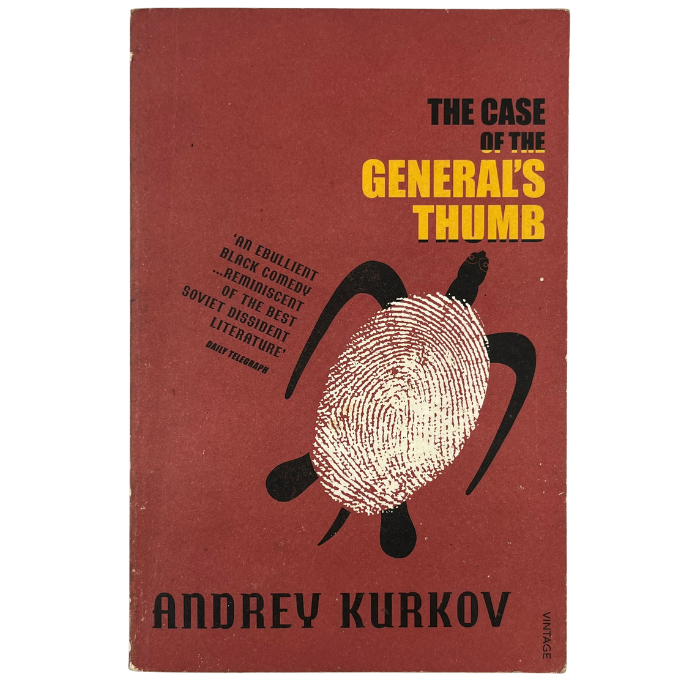

Ratings: ★★★★☆ (4.3/5)
Genre: Crime Fiction, Black Comedy, Mystery, Satire, Literary Fiction
Book Review:
Andrey Kurkov is one of those writers who defies easy categorization. He's been called a satirist, a crime novelist, a surrealist, a black comedian—and all of these labels fit, but none captures the full scope of his achievement. ''The Case of the General's Thumb,'' his follow-up to the acclaimed ''Death and the Penguin,'' is a brilliant example of his unique vision.
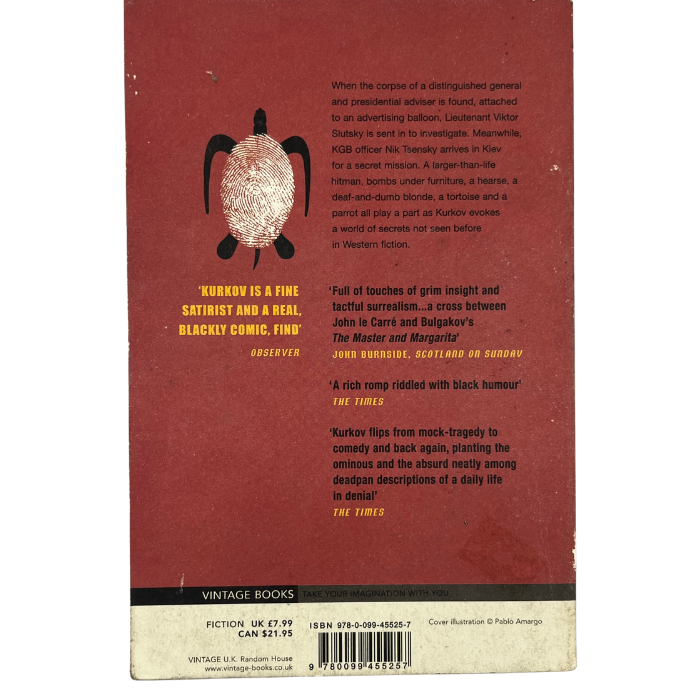
The novel opens with an image straight out of a surrealist painting: the corpse of a distinguished general, attached to an advertising balloon, floating over the city of Kiev. It's a scene that announces Kurkov's intentions clearly—this is not a conventional crime novel. The investigation that follows, led by Lieutenant Viktor Slutsky, takes us deep into a world where nothing is quite what it seems.
Parallel to Slutsky's investigation runs the story of Nik Tsensky, a KGB officer sent to Kiev on a secret mission. Tsensky is a wonderful creation—a man so deep undercover that he's almost forgotten who he really is. His mission, like everything in this novel, is both absurd and deadly serious.
Kurkov populates his novel with a cast of unforgettable characters: a hitman who's larger than life (literally and figuratively), a deaf-and-dumb blonde who may or may not be what she seems, a tortoise that serves as a silent observer, and a parrot that might be the most sensible character of all. Bombs are hidden under furniture, hearses play unexpected roles, and the line between accident and design blurs beyond recognition.
What makes Kurkov's work so distinctive is his tone. He writes with a deadpan matter-of-factness that makes the most outrageous events seem almost plausible. The surrealism is never announced with fanfare—it simply emerges from the everyday details of post-Soviet life. A corpse on a balloon? Well, yes, that's the sort of thing that might happen. A hitman who quotes philosophy? Of course. A tortoise as a companion? Naturally.
This tone allows Kurkov to explore serious themes without ever becoming heavy-handed. He's writing about a society in transition—the chaos of post-Soviet Ukraine, where old certainties have collapsed and new ones haven't yet emerged. The KGB is still there, but its power is uncertain. The police investigate crimes, but nothing works the way it should. Ordinary people try to live ordinary lives in extraordinary circumstances.
The critical reception has been appropriately enthusiastic. The Observer calls Kurkov ''a fine satirist and a real, blackly comic, find.'' John Burnside, writing in Scotland on Sunday, compares him to a cross between John le Carré and Bulgakov's ''The Master and Margarita''—high praise indeed. The Times notes that ''Kurkov flips from mock-tragedy to comedy and back again, planting the ominous and the absurd neatly among deadpan descriptions of a daily life in denial.''
For readers who enjoy crime fiction with a twist—or who appreciate the dark humor of writers like Mikhail Bulgakov or Franz Kafka—''The Case of the General's Thumb'' is a treasure. It's a novel that will make you laugh, think, and see the world a little differently. Highly recommended.