Free Support 24/7
011 208 1308

Free Support 24/7
011 208 1308

Ratings: ★★★★☆(4.7/5)
Genre: History / Indian History / Military History / Biography
Book Review:
A Revisionist Masterpiece That Gives a Voice to the Vanquished
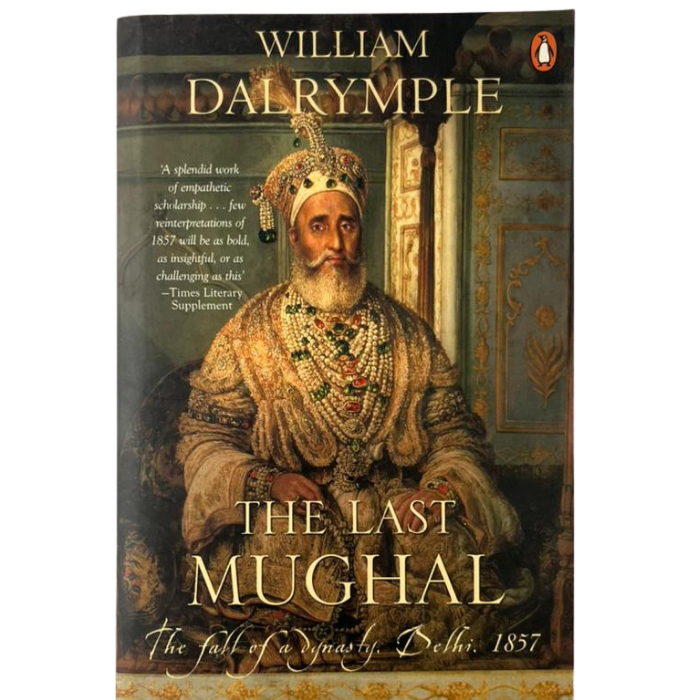
William Dalrymple's ''The Last Mughal'' is a triumph of historical writing. It takes one of the most cataclysmic events in the history of the British Empire—the Indian Uprising of 1857—and turns the traditional narrative on its head, giving voice and agency to the Indian side of the story for the first time. The result is a book that is as insightful and revisionist as it is heartbreaking and beautifully written.
At the heart of the story is Bahadur Shah Zafar II, the last Mughal emperor. By 1857, he was a frail, 82-year-old poet, a man more interested in Sufi mysticism and calligraphy than in politics, ruling over a Delhi that was a shadow of its former glorious self. Dalrymple paints a vivid portrait of this ''twilight'' Delhi—a city of extraordinary cultural richness, where Hindu and Muslim traditions blended seamlessly, and where poets and scholars thrived even as the British East India Company tightened its grip on power.
When the mutiny erupted among the Company's Indian troops, the sepoys flocked to Zafar's Red Fort, declaring him their leader. Reluctantly, he gave them his blessing, and a local rebellion was transformed into a massive uprising. The book then follows the brutal siege of Delhi, the desperate fighting, and the horrific British retaliation that followed. Dalrymple draws on a wealth of previously unused Urdu and Persian sources—diaries, letters, and court records—to bring the Indian experience of the siege to life. We hear the voices of the poets, the merchants, the courtiers, and the ordinary citizens of Delhi, all of whom were caught up in a tragedy of immense proportions.
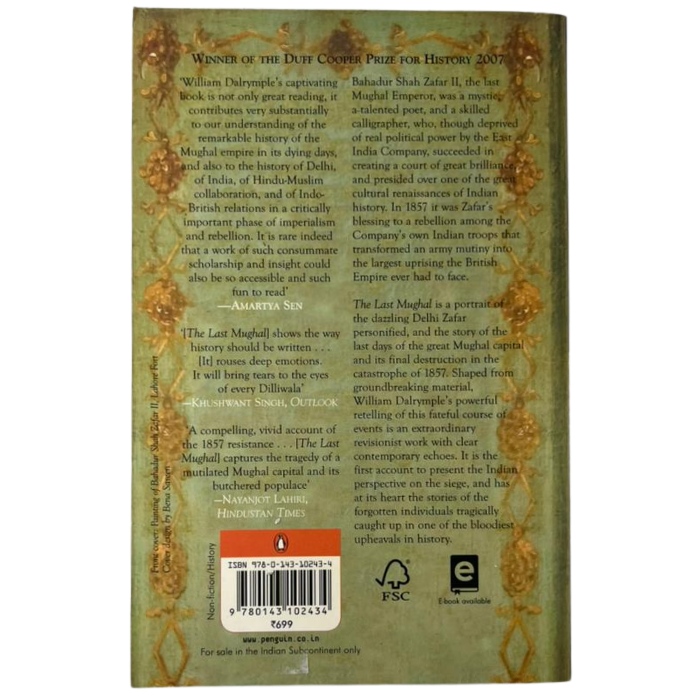
The Times Literary Supplement called it ''a splendid work of empathetic scholarship,'' and it is hard to disagree. ''The Last Mughal'' is not just a great work of history; it is a deeply moving human story about the end of an era, the destruction of a civilization, and the tragic fate of a man who was, in the end, a poet caught up in a war he never wanted. Essential reading.