Free Support 24/7
011 208 1308

Free Support 24/7
011 208 1308

Ratings: ★★★★★ (5/5)
Genre: Poetry / Romantic Literature / Literary Criticism
Book Review:
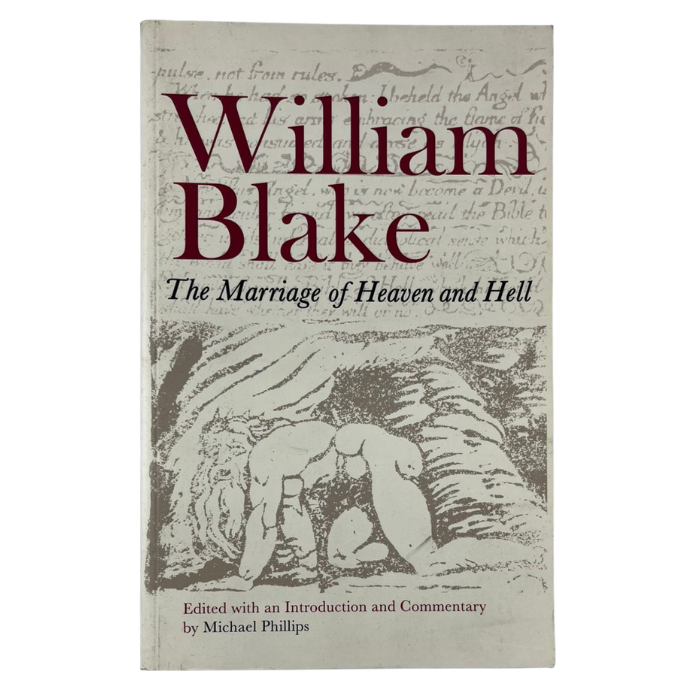
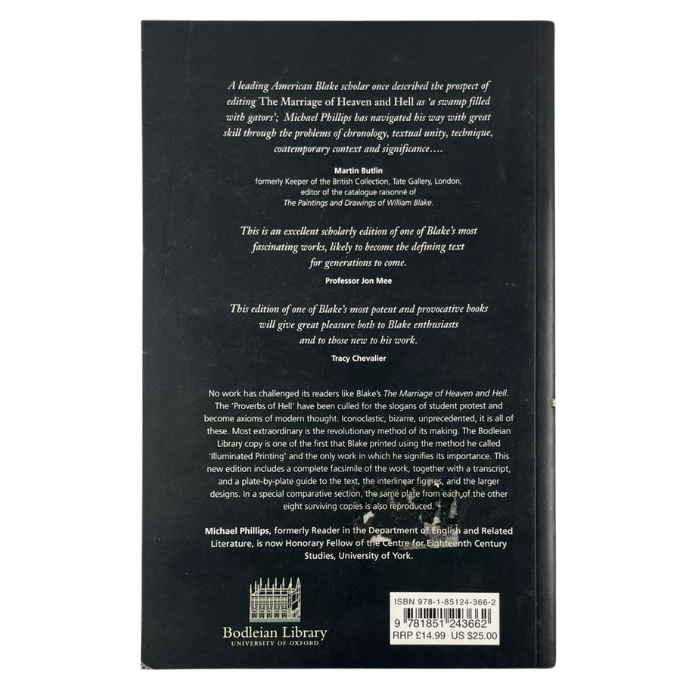
William Blake's ''The Marriage of Heaven and Hell'' has challenged readers for over two centuries. As the back cover notes, its ''Proverbs of Hell'' have been quoted in student protests and have become axioms of modern thought. Iconoclastic, bizarre, unprecedented—these words only begin to capture the experience of encountering this work. Now, Michael Phillips has produced an edition that does full justice to Blake's achievement.
The book is one of Blake's most extraordinary creations. Written and illustrated between 1790 and 1793, it presents a vision of the world that turns conventional morality on its head. Blake rejects the separation of good and evil, body and soul, reason and energy. ''Without Contraries is no progression,'' he writes. ''Attraction and Repulsion, Reason and Energy, Love and Hate, are necessary to Human existence.'' The work is a satire on Emanuel Swedenborg's theological writings, a celebration of creative energy, and a manifesto for a new kind of art.
But what makes this edition so valuable is its attention to Blake's method of production. Blake called his technique ''illuminated Printing,'' and it was revolutionary: he etched both text and image onto copper plates, printed them in color, and then hand-finished each copy. No two copies are exactly alike. This edition reproduces in full the Bodleian Library copy, one of the first Blake printed, and includes sample plates from each of the other eight surviving copies. For the first time, readers can see the variations across copies and appreciate Blake's work as he intended it.
The scholarly apparatus is exemplary. Michael Phillips, formerly Reader at the University of York and now Honorary Fellow of the Centre for Eighteenth Century Studies, provides an introduction that situates the work in its historical and intellectual context. His plate-by-plate guide explains the text, the interlunar figures, and the larger designs. The transcript makes the text accessible while the facsimile preserves the visual experience.
The endorsements are impressive. Martin Butlin, former Keeper of the British Collection at the Tate Gallery and editor of the catalogue raisonné of Blake's paintings and drawings, praises Phillips for navigating ''with great skill through the problems of chronology, textual unity, technique, contemporary context and significance.'' Professor Jon Mee calls it ''an excellent scholarly edition... likely to become the defining text for generations to come.'' Novelist Tracy Chevalier notes that it will ''give great pleasure both to Blake enthusiasts and to those new to his work.''
For students of Blake, this edition is indispensable. For poetry lovers, it offers access to a masterpiece in its proper form. For anyone interested in the intersection of text and image, it provides a fascinating case study. And for all readers, it is an invitation into the mind of one of England's most original and visionary artists.
Blake wrote: ''If the doors of perception were cleansed every thing would appear to man as it is, Infinite.'' This edition helps cleanse those doors. It is a work of scholarship that is also a work of love, and it deserves a place in every serious library of English literature. Highly recommended.

190720-img.png)