Free Support 24/7
011 208 1308

Free Support 24/7
011 208 1308

ratings: ★★★★★ (4.7/5)
Genre: Classic Literature, Fiction, Psychological Fiction
Book Review:
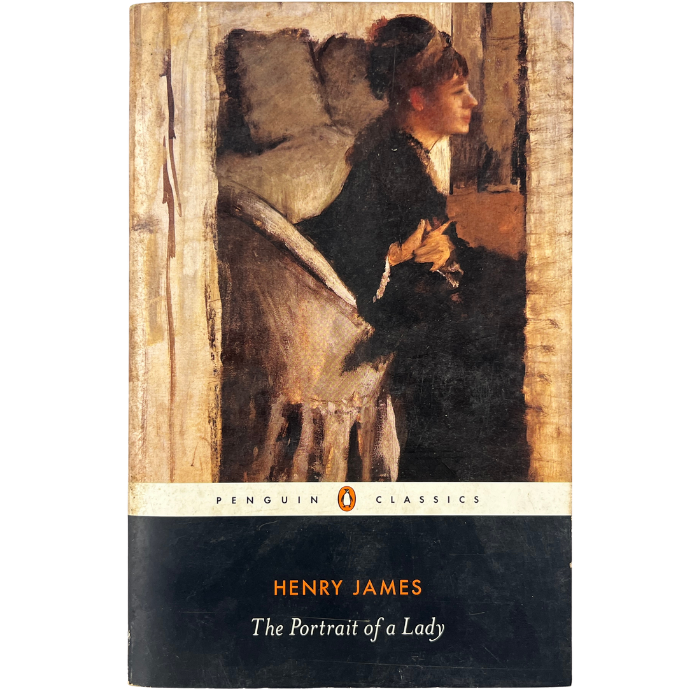
Henry James's The Portrait of a Lady is not a novel you simply read; it is a novel you inhabit. It is a work of immense psychological depth and subtlety, a rich and complex exploration of a young woman's journey into the heart of her own destiny. It is widely considered James's masterpiece, and it is easy to see why.
The novel introduces us to Isabel Archer, a young American woman of ''extraordinary charm'' and a fierce, almost reckless, desire for freedom. She is brought to Europe by her wealthy aunt and is immediately confronted with a world of sophistication, tradition, and hidden motives. She is determined to make her own choices, to live life on her own terms. When she inherits a fortune, she believes it will give her the power to do just that.
Isabel rejects two very eligible suitors: the passionate and persistent Caspar Goodwood, and the noble, kind Lord Warburton. They represent, in different ways, the kind of conventional happiness she thinks she wants to avoid. Instead, she is drawn to Gilbert Osmond, an American expatriate living in Florence. Osmond is charming, cultivated, and seemingly refined. He appears to share Isabel's appreciation for art and beauty. But he is a man of chilling self-regard, a collector of beautiful objects, and he sees Isabel as the most beautiful object of all.
The second half of the novel is a slow, devastating revelation of the mistake Isabel has made. Trapped in a marriage that has become a prison, she must confront the consequences of her choice. She discovers the true nature of her husband and the duplicity of her friend, Madame Merle, who orchestrated the match. The novel's final sections, in which Isabel must decide whether to stay in her miserable marriage or leave, are among the most moving and morally complex in all of literature.
The Portrait of a Lady is a novel about many things: the nature of freedom, the illusions of innocence, the corrupting power of wealth, and the complexity of human relationships. But above all, it is a portrait of a woman's consciousness. James takes us inside Isabel's mind, showing us her thoughts, her hopes, her fears, and her gradual, painful disillusionment. She is one of the great heroines of literature, a character of such depth and reality that she seems to live beyond the pages of the book.
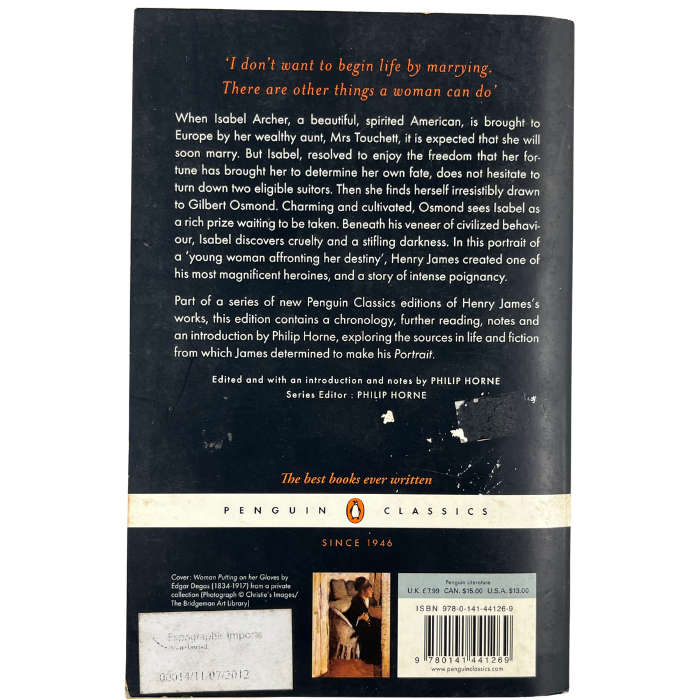
This Penguin Classics edition, edited by Philip Horne, is superb. Horne's introduction is insightful and comprehensive, and his notes are invaluable for understanding James's rich and allusive prose. The cover, featuring Edgar Degas's ''Woman Putting on Her Gloves,'' perfectly captures the novel's atmosphere of elegant surfaces and hidden depths.
The Portrait of a Lady is an essential read for anyone who loves great literature. It is a novel that demands to be read slowly, savored, and reread. It is a profound and beautiful work of art, a timeless masterpiece. Highly recommended.