Free Support 24/7
011 208 1308

Free Support 24/7
011 208 1308

Ratings: ★★★★☆(4.6/5)
Genre: Philosophy / Western Philosophy / Classics / Religion
Book Review:
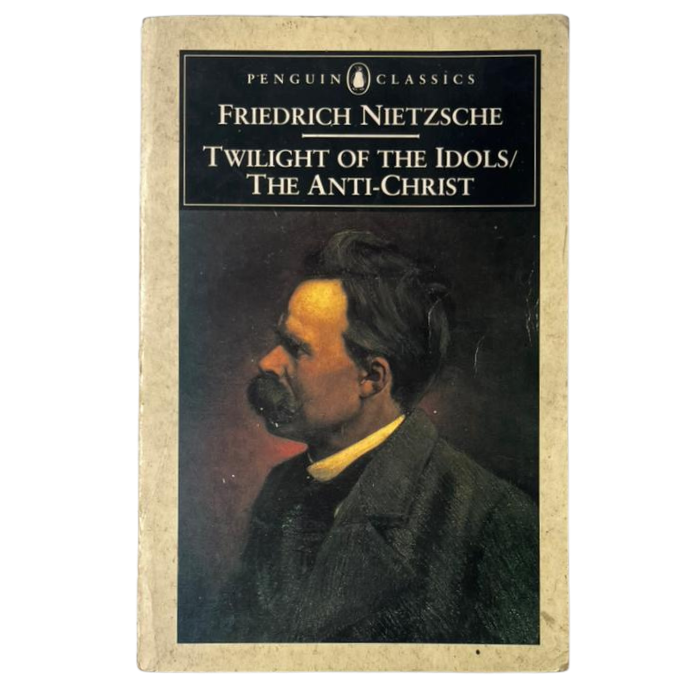
Nietzsche's Devastating Final Assault
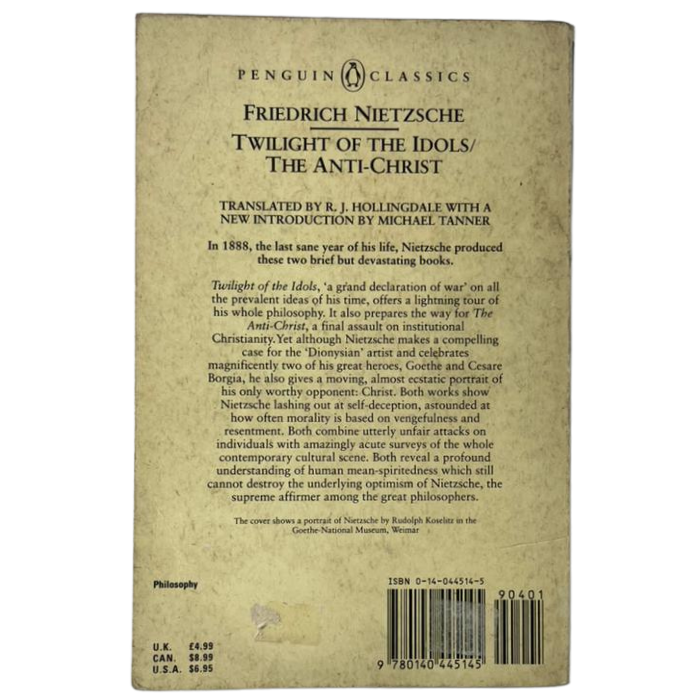
In 1888, the year before his mental collapse, Friedrich Nietzsche produced two of his most brilliant and incendiary works. ''Twilight of the Idols'' and ''The Anti-Christ'' are the philosopher at his most direct, his most passionate, and his most devastating. This Penguin Classics volume, superbly translated by R.J. Hollingdale, is the perfect way to experience these philosophical dynamite sticks.
''Twilight of the Idols'' is subtitled ''How to Philosophize with a Hammer,'' and that is exactly what Nietzsche does. He takes a hammer to the ''idols'' of his age—the cherished beliefs, the moral certainties, the philosophical systems—and smashes them to pieces. It is a whirlwind tour of his entire philosophy, touching on his critiques of Socrates, Plato, Kant, and Christianity, and his celebration of art, instinct, and the ''Dionysian'' spirit. It is, as the introduction notes, a ''grand declaration of war'' on all that he opposed.
''The Anti-Christ'' is an even more focused and ferocious attack. Here, Nietzsche targets Christianity not as a faith, but as an institution, a system of values that he believed had poisoned Western civilization. He argues that it is a ''slave morality'' born of resentment, a denial of life itself in favor of a fictional afterlife. Yet, in a typically Nietzschean twist, he also offers a strangely moving portrait of Jesus as a figure he admires, distinguishing him sharply from the religion built in his name.
These are not easy books to read. They are challenging, provocative, and often deeply unsettling. But they are also exhilarating. Nietzsche's prose is electric, his insights are sharp as a blade, and his passion is infectious. He forces you to question everything you thought you knew about morality, religion, and truth. As Michael Tanner's excellent introduction makes clear, these works reveal Nietzsche as both a supreme critic and a supreme affirmer—a philosopher who, even in his darkest moments, never lost his faith in life.
For anyone interested in philosophy, this volume is essential reading. It is a brilliant and bracing introduction to one of history's most original and influential thinkers.