Free Support 24/7
011 208 1308

Free Support 24/7
011 208 1308
Ratings: ★★★★☆ (4.5/5)
Genre: Memoir, Public Administration, Sri Lankan History, Biography
Book Review:
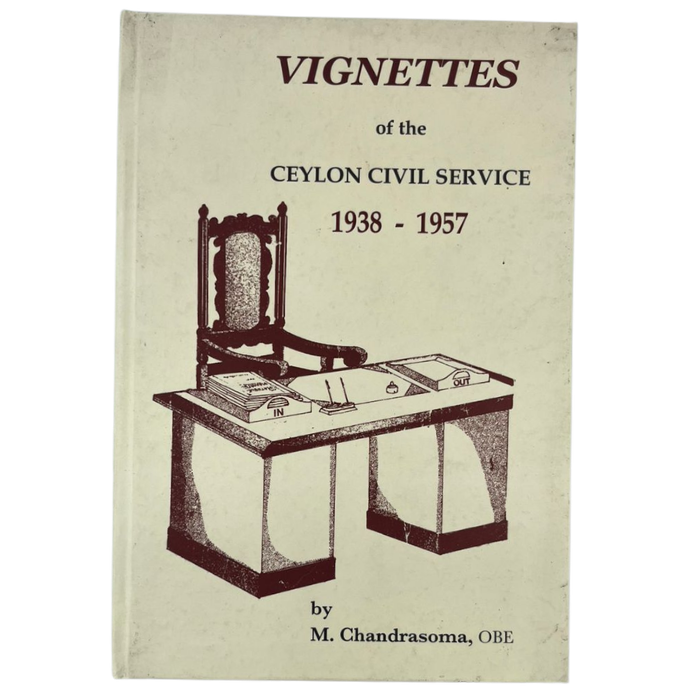
''Vignettes of the Ceylon Civil Service'' offers readers a rare and valuable glimpse into the inner workings of colonial and early post-colonial administration in Sri Lanka through the eyes of one who served at its highest levels. M. Chandrasoma's memoir, edited and published by his sons, is both a personal testament and a historical document of considerable importance.
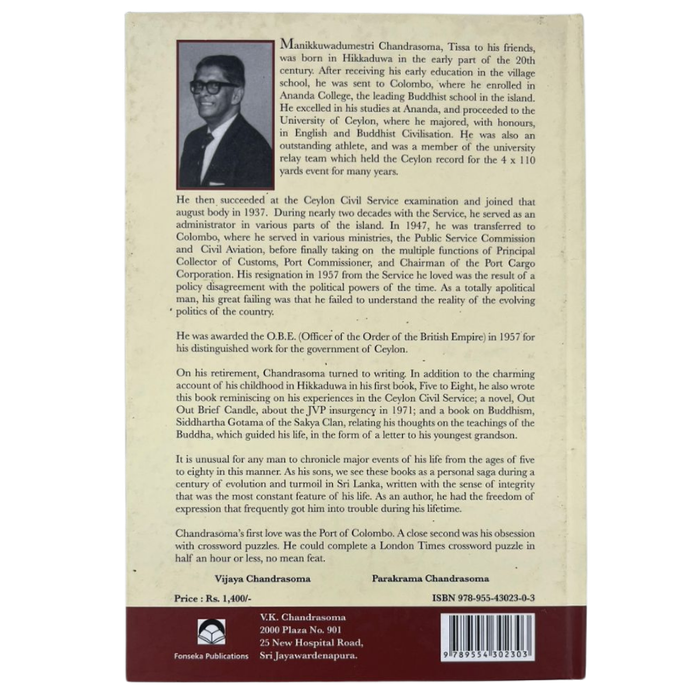
Chandrasoma's career trajectory was remarkable by any measure. From village school in Hikkaduwa to Ananda College, from the University of Ceylon (where he excelled academically while also holding a relay record) to the prestigious Ceylon Civil Service—his journey embodied the possibilities opening up for talented Ceylonese in the late colonial period. His service from 1937 to 1957 spanned the transition from British rule to independence, placing him at the center of the administrative challenges that accompanied political change.
The book's title accurately signals its approach: these are ''vignettes,'' not a systematic treatise. Chandrasoma offers glimpses, episodes, and reflections rather than comprehensive analysis. This approach has the virtue of intimacy—readers encounter the human realities of administrative life, the personalities, the dilemmas, the small moments that collectively shaped a career. His posting in various parts of the island before 1947 gave him intimate knowledge of Ceylon's diversity, while his later Colombo positions—including the extraordinary combination of Principal Collector of Customs, Port Commissioner, and Chairman of the Port Cargo Corporation—placed him at the center of economic administration.
The circumstances of his resignation in 1957 are particularly revealing. As his sons note in their preface, Chandrasoma was ''a totally apolitical man'' whose ''great failing was that he failed to understand the reality of the evolving politics of the country.'' His policy disagreement with political authorities led him to leave the service he loved—a reminder of the tensions between professional administrators and elected politicians that accompanied independence across the former colonial world.
Chandrasoma's later literary career adds context to this memoir. His other works—including the childhood memoir ''Five to Eight,'' the novel ''Out Out Brief Candle'' (about the 1971 JVP insurgency), and ''Siddhartha Gotama of the Sakya Clan'' (on Buddhist teachings)—demonstrate the range of his interests and his commitment to writing as a form of continuing contribution after retirement.
For readers interested in Sri Lankan administrative history, the transition from colonial to independent government, or simply the story of a dedicated public servant navigating turbulent times, this book is essential reading. It stands alongside Chandrasoma's other works as part of ''a personal saga during a century of evolution and turmoil in Sri Lanka, written with the sense of integrity that was the most constant feature of his life.''