Free Support 24/7
011 208 1308

Free Support 24/7
011 208 1308

Ratings: ★★★★☆ (4.6/5)
Genre: Memoir, Political Biography, Sri Lankan History, Education
Book Review:
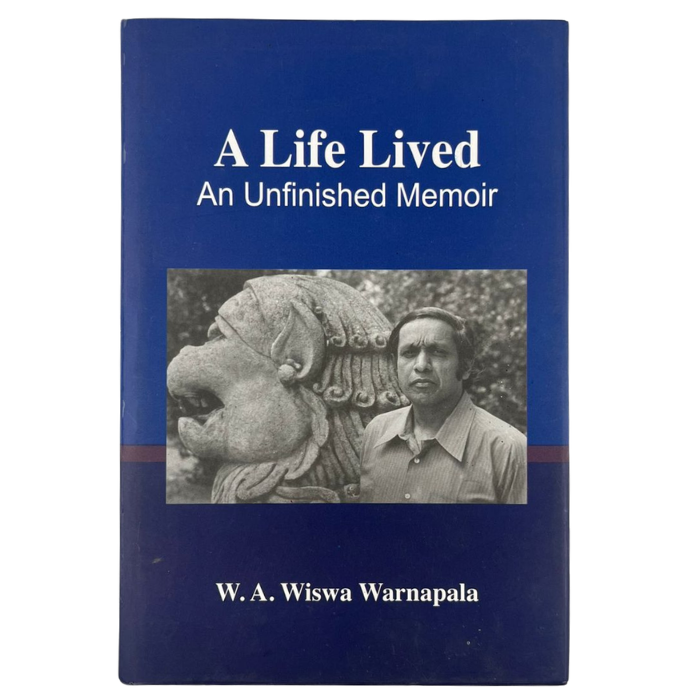
''A Life Lived: An Unfinished Memoir'' arrives with a poignancy that its title itself suggests. This is the final work of Professor W. A. Wiswa Warnapala, a figure whose extraordinary career spanned the heights of academia and government, and whose ''unfinished'' status reminds us that even the fullest lives end with stories still untold.
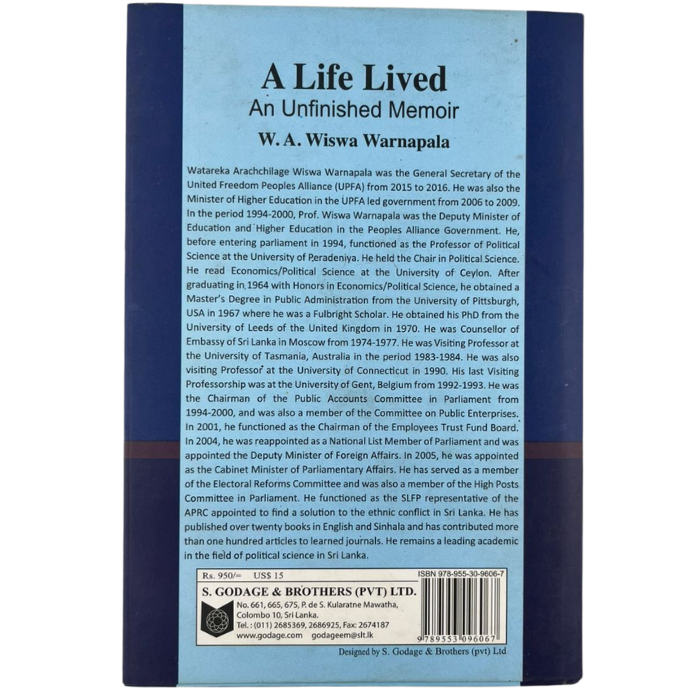
What makes this memoir invaluable is the unique perspective Warnapala brings. He is that rare individual who achieved distinction in both scholarship and politics—a Professor of Political Science who held the Chair at Peradeniya, and a Cabinet Minister who shaped national policy. This dual identity informs every page, offering readers insights available only to someone who has inhabited both the ivory tower and the corridors of power.
The trajectory Warnapala traces is remarkable by any measure. From his early education at the University of Ceylon, through his Fulbright year at Pittsburgh and doctoral studies at Leeds, to his professorial career and subsequent entry into parliament—each phase reveals a mind engaged with the fundamental questions of governance, development, and national identity. His service as Counsellor in Moscow during the Cold War years adds an international dimension that enriches his analysis of Sri Lanka's place in the world.
The memoir covers his multiple ministerial roles—Deputy Minister of Education and Higher Education, Minister of Higher Education, Deputy Minister of Foreign Affairs, Minister of Parliamentary Affairs—as well as his chairmanship of the Public Accounts Committee and his work on the APRC addressing the ethnic conflict. Throughout, Warnapala writes with the analytical clarity of a political scientist and the practical wisdom of a practitioner.
His bibliography—over twenty books in English and Sinhala, more than one hundred scholarly articles—testifies to a life of intellectual productivity that continued alongside his political career. This memoir thus represents not a departure from his scholarly work but its culmination: the application of a lifetime's learning to the story of a life lived.
The book's ''unfinished'' quality may actually enhance its value. It reminds readers that memoirs are not final judgments but contributions to ongoing conversations. Warnapala has given us his perspective; we must continue the work of interpretation.
For anyone seeking to understand Sri Lanka's political evolution, the relationship between academia and government, or simply the story of a life dedicated to public service and intellectual inquiry, ''A Life Lived'' is essential reading. It stands as a fitting final chapter to a career that, though ended, remains unfinished in the sense that its influence will continue through those who read and learn from it.