Free Support 24/7
011 208 1308

Free Support 24/7
011 208 1308

ratings: ★★★★★ (4.6/5)
Genre: Buddhist Philosophy, Religious Studies, Mythology, Comparative Religion
Book Review:
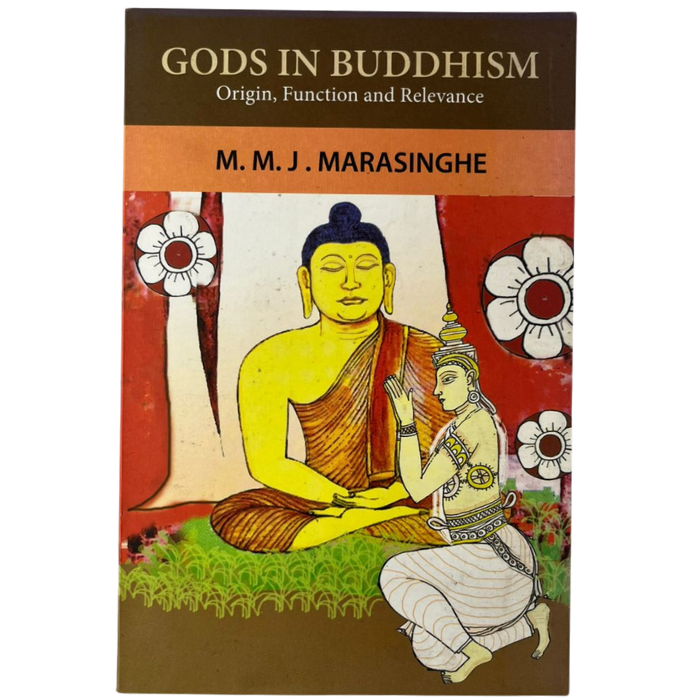
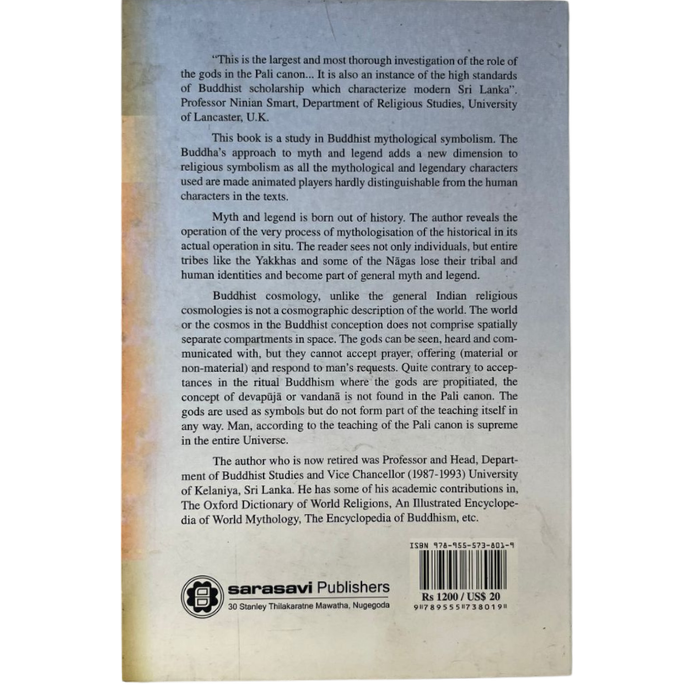
Professor M.M.J. Marasinghe's ''Gods in Buddhism: Origin, Function and Relevance'' is a monumental and erudite work that stands as a landmark in Buddhist scholarship. As Professor Ninian Smart of the University of Lancaster states in his endorsement, it is ''the largest and most thorough investigation of the role of the gods in the Pali canon'' and ''an instance of the high standards of Buddhist scholarship which characterize modern Sri Lanka.''
This book is a profound exploration of Buddhist mythological symbolism. Marasinghe, a distinguished scholar who served as Professor and Head of Buddhist Studies and Vice Chancellor at the University of Kelaniya, brings a lifetime of expertise to this study. He meticulously examines how the Buddha approached myth and legend, revealing a process that adds a unique dimension to religious symbolism. The mythological and legendary characters in the texts are not distant, abstract figures; they are ''made animated players hardly distinguishable from the human characters.''
A key contribution of the book is its demonstration of the very process of mythologization. Marasinghe shows how historical individuals, and even entire tribes like the Yakkhas and some Nāgas, ''lose their tribal and human identities and become part of general myth and legend.'' The reader witnesses this transformation in action.
The book also offers a crucial clarification of Buddhist cosmology, distinguishing it from other Indian religious cosmologies. The Buddhist cosmos, Marasinghe argues, is not a series of ''spatially separate compartments.'' Gods can be seen, heard, and communicated with, but a radical distinction is made: they ''cannot accept prayer; offering (material or non-material) and respond to man's requests.'' The concept of devapūjā (worship of gods) or vandanā is not found in the Pali canon. The gods are used as symbols but do not form part of the core teaching itself. This stands in stark contrast to the practices of ritual Buddhism where gods are propitiated.
The author's ultimate conclusion is profound and central to Buddhist thought: ''Man, according to the teaching of the Pali canon is supreme in the entire Universe.'' This book is an essential read for any serious student of Buddhism, religious studies, or comparative mythology. It is a testament to the depth and sophistication of Sri Lankan Buddhist scholarship and a work that will be referenced for generations.