Free Support 24/7
011 208 1308

Free Support 24/7
011 208 1308

Ratings: ★★★★☆ (4/5)
Genre: Anthropology / Cultural Studies / Sri Lankan Studies
Book Review:
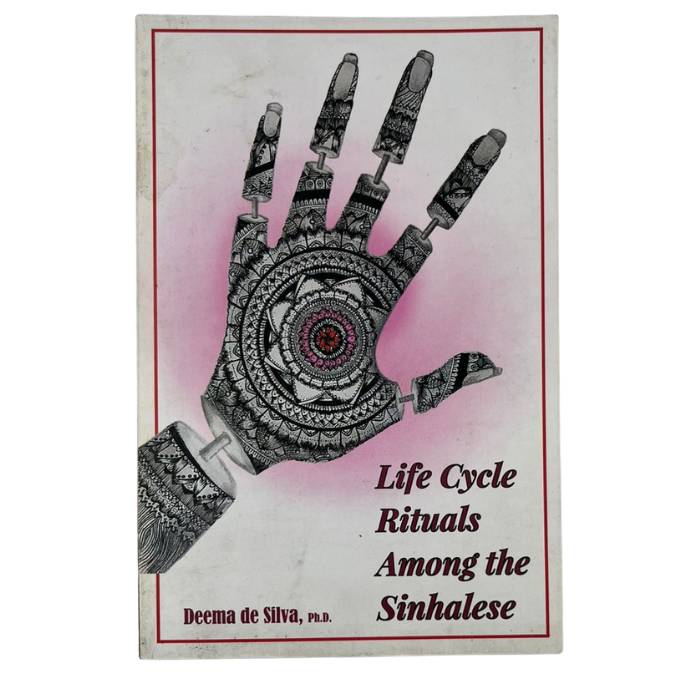
Dr. Deema de Silva's ''Life Cycle Rituals Among the Sinhalese'' is a valuable contribution to the ethnographic literature on Sri Lanka, offering a detailed and sensitive portrait of how one community navigates the transitions of human life through culturally prescribed rituals.
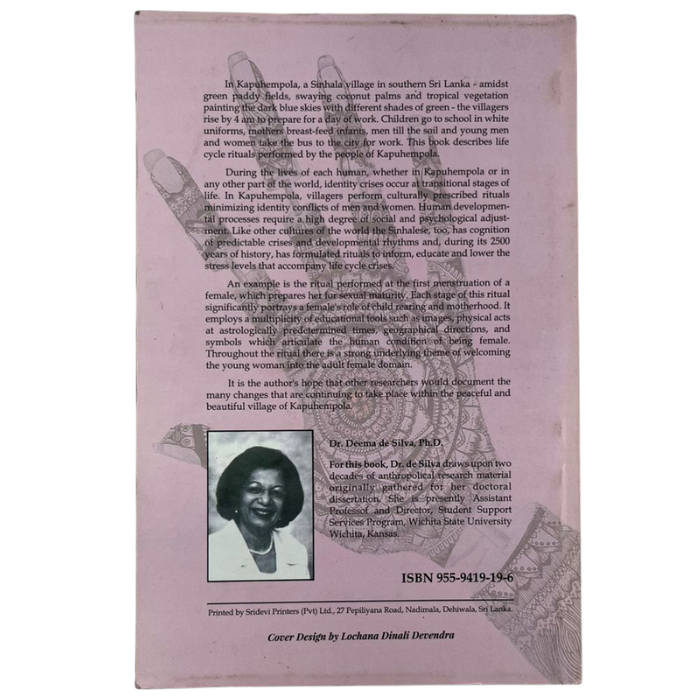
The book is set in Kapuhempola, a Sinhala village in southern Sri Lanka—a place of green paddy fields, swaying coconut palms, and tropical vegetation. De Silva paints a vivid picture of village life: villagers rising by 4 am, children in white uniforms heading to school, mothers breastfeeding infants, men tilling the soil, young people taking buses to the city for work. It is into this living community that she embeds her study of rituals.
Drawing on two decades of research originally gathered for her doctoral dissertation, De Silva examines the rituals that mark key life transitions: birth, puberty, marriage, and death. Her approach is anthropological but accessible, grounded in theory but attentive to the lived experience of the villagers she studied.
The book's strength is its detailed description of specific rituals. The chapter on the first menstruation ritual is particularly rich, showing how the ceremony prepares a girl for sexual maturity and welcomes her into the adult female domain. De Silva analyzes the ''multiplicity of educational tools'' employed: images, physical acts performed at astrologically predetermined times, geographical directions, and symbols that articulate the female condition. Throughout the ritual runs ''a strong underlying theme of welcoming the young woman into the adult female domain.''
De Silva argues that these rituals serve important psychological and social functions. Human development requires significant adjustment, and life cycle crises can create identity conflicts. The rituals, she suggests, help minimize these conflicts by providing structure, meaning, and community support during transitional periods.
The author's position is interesting: she is both an insider (as a Sinhalese person) and an outsider (as a Western-trained academic now teaching in the United States). This dual perspective allows her to combine empathetic understanding with analytical distance. Her hope, expressed at the end, is that ''other researchers would document the many changes that are continuing to take place within the peaceful and beautiful village of Kapuhempola.''
The book is published in Sri Lanka and may not be widely available internationally, but for scholars of Sri Lankan culture, it is an important resource. For students of anthropology, it offers a case study of how ritual functions in a specific cultural context. And for anyone interested in the Sinhalese people and their traditions, it provides a window into a world that is changing but still alive.
De Silva, now Assistant Professor and Director of Student Support Services at Wichita State University, has given us a work of careful scholarship and evident affection. ''Life Cycle Rituals Among the Sinhalese'' deserves a place in any serious collection on Sri Lankan ethnography.