Free Support 24/7
011 208 1308

Free Support 24/7
011 208 1308

Ratings: ★★★★★ (5/5)
Genre: Medical History / Science / Biography
Book Review:
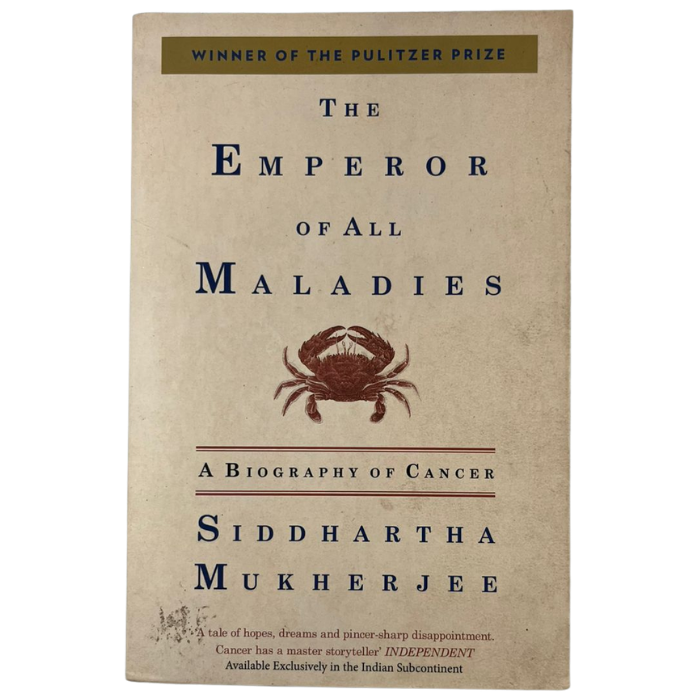
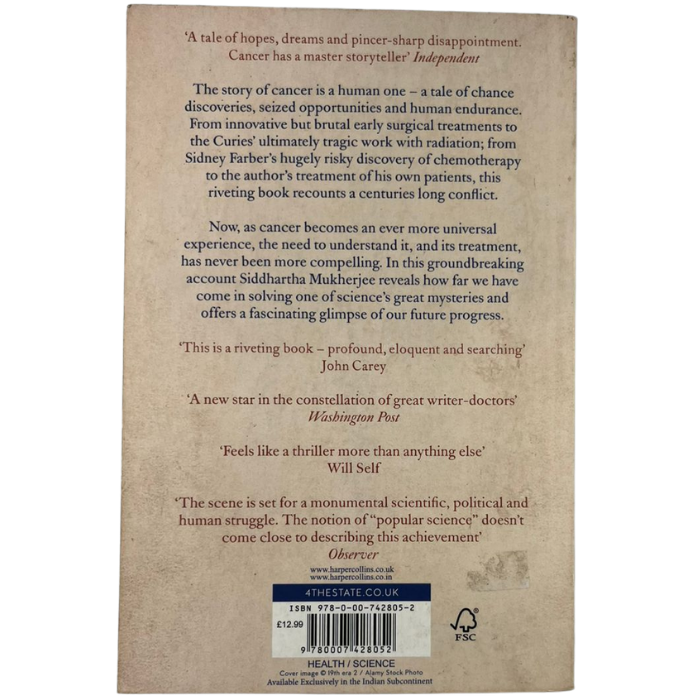
Siddhartha Mukherjee's ''The Emperor of All Maladies'' is one of those rare books that deserves every accolade it has received. Winner of the Pulitzer Prize, it has been hailed by the Independent as a tale where ''cancer has a master storyteller,'' by the Observer as ''monumental,'' and by Will Self as reading ''like a thriller.'' These are not exaggerations.
The book is an audacious attempt to write a ''biography'' of cancer—to trace its history, its character, its impact on humanity, and humanity's impact on it. Mukherjee, a practicing oncologist and researcher, is uniquely qualified for this task. He brings both scientific expertise and deep compassion to his subject, and he writes with the skill of a novelist.
The story begins with the earliest known descriptions of cancer in ancient Egypt and moves through the centuries: the first surgeries (before anesthesia, before antisepsis), the discovery of radiation and its tragic consequences for pioneers like Marie Curie, the development of chemotherapy by Sidney Farber and others, the long and often bitter debates about the causes of cancer, and the recent explosion of knowledge about genetics and targeted therapies.
But this is not just a history of science. It is a human story, filled with characters: patients who endured experimental treatments, doctors who risked their careers on radical ideas, researchers who spent decades pursuing a single insight. Mukherjee tells their stories with empathy and skill, making us care about people we've never met.
The book also raises profound questions. What does it mean to fight a disease that is, in some sense, ourselves—cancer being our own cells run amok? How do we balance hope and honesty in treating patients? What is the relationship between knowledge and power, between research and profit? Mukherjee doesn't offer easy answers, but he illuminates the questions.
The Washington Post calls Mukherjee ''a new star in the constellation of great writer-doctors,'' placing him in the company of Oliver Sacks and Atul Gawande. This is apt. Like those writers, Mukherjee combines scientific authority with literary grace and human warmth.
For anyone affected by cancer—which is to say, almost everyone—this book is essential reading. It offers understanding, context, and a sense of the long struggle that has brought us to where we are. For students of medicine and science, it is a masterclass in how to tell the story of a disease. And for general readers, it is simply one of the most fascinating and moving books you will ever read.