Free Support 24/7
011 208 1308

Free Support 24/7
011 208 1308

Ratings: ★★★★☆(4.4/5)
Genre: Science Fiction, Space Opera, Classic Sci-Fi
Book Review:
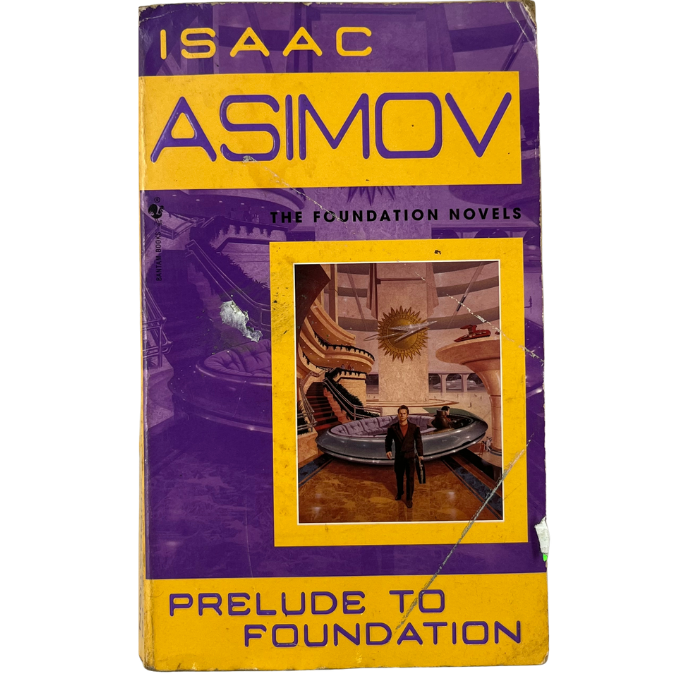
Isaac Asimov's Foundation series is one of the cornerstones of science fiction—a sweeping epic that has inspired generations of readers and writers. ''Prelude to Foundation,'' written decades after the original trilogy, returns to the beginning of the story, offering fans a chance to see how it all started.
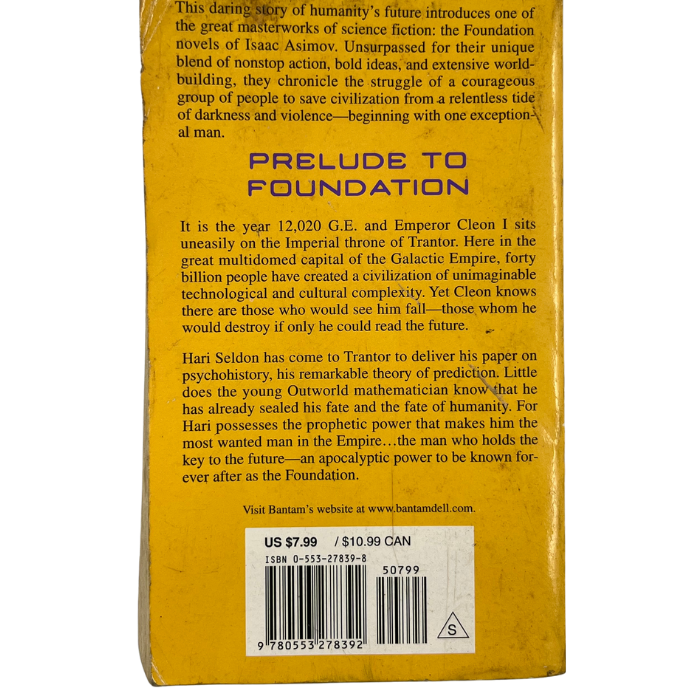
The novel is set on Trantor, the capital planet of the Galactic Empire—a world entirely covered by a single massive city, home to forty billion people. It's a marvel of science fiction world-building: a planet of metal and glass, of corridors and domes, where the sky is never seen and the sun is only a rumor.
Into this world comes Hari Seldon, a young mathematician from a provincial planet. He's come to present a paper on a new theory he's developed: psychohistory, a mathematical method for predicting the future of large populations. He expects his paper to be a academic curiosity, nothing more.
Instead, it sets off a firestorm.
The Emperor, Cleon I, sees psychohistory as a tool to maintain his power. The nobles see it as a threat. The scientists see it as a breakthrough. The religious leaders see it as heresy. And all of them want to control Seldon—or destroy him.
Forced to flee across Trantor, Seldon is guided by a journalist named Dors Venabili, who becomes his protector, his guide, and eventually something more. Together they navigate the complex layers of Trantorian society, from the ancient Dahl sector to the mysterious Mycogenian culture to the high-tech world of the Imperial Palace.
Asimov's prose is clear and engaging, as always. He has a gift for making complex ideas accessible and for creating worlds that feel real. The novel is less about action than about ideas—politics, sociology, history—but it moves at a good pace, with enough twists and turns to keep readers engaged.
For fans of the Foundation series, ''Prelude to Foundation'' is essential reading. It fills in gaps, explains origins, and deepens appreciation for the original trilogy. For newcomers, it's a fine place to start, though some may prefer to begin with the original ''Foundation'' and then return to this prequel.
The novel is also a meditation on the nature of prediction and power. Can the future really be predicted? If it can, should we try? And what happens when those predictions fall into the wrong hands? These questions are as relevant today as when Asimov first explored them.
''Prelude to Foundation'' is a worthy addition to a classic series. Recommended for science fiction fans and anyone interested in grand, thought-provoking storytelling.