Free Support 24/7
011 208 1308

Free Support 24/7
011 208 1308


Ratings: ★★★★☆ (4.5/5)
Genre: Science Fiction, Speculative Fiction, Literary Fiction
Book Review:
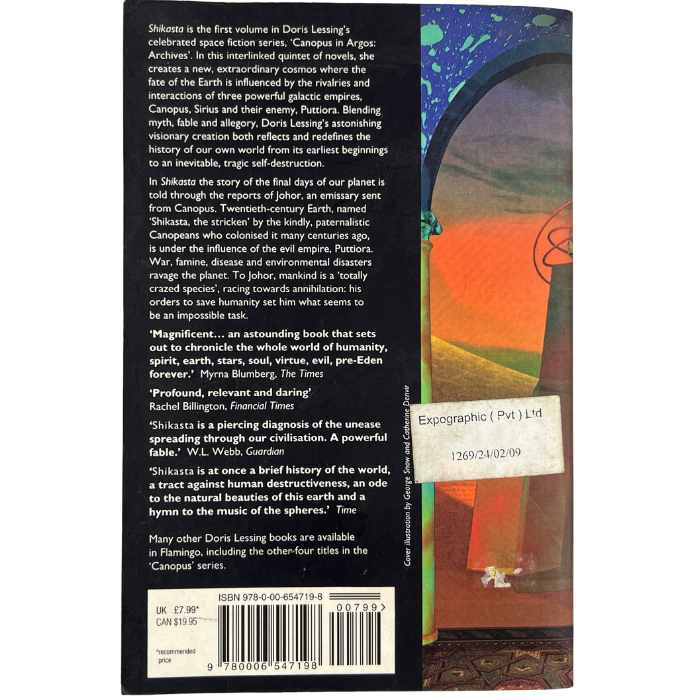
Doris Lessing's ''Shikasta'' is a novel of immense ambition and scope, a book that boldly reimagines the history of our world through the lens of galactic politics and cosmic myth. It is the first in her ''Canopus in Argos'' series, and it is a stunning, challenging, and deeply thought-provoking read. The novel is presented as a series of reports from Johor, an emissary from the advanced, benevolent empire of Canopus. He has been sent to ''Shikasta''—Earth—to observe and, if possible, to save a planet that has fallen under the corrupting influence of the evil empire, Puttiora. Through his eyes, we see the entire span of human history, from its Edenic origins to its catastrophic, self-inflicted end. War, famine, disease, environmental collapse—it's all here, viewed from a cosmic perspective that makes our petty squabbles and self-destructive tendencies seem both tragic and absurd. This is not a conventional science fiction novel. There are no laser guns or spaceship battles. Instead, it is a work of philosophical fiction, a kind of allegorical history of the world. Lessing uses the framework of galactic empires to explore profound questions about human nature, the nature of good and evil, and the possibility of redemption. It is a powerful indictment of our civilization, a ''piercing diagnosis of the unease spreading through our civilisation,'' as the Guardian put it. Lessing's prose is clear, precise, and often beautiful. She creates a world that is both alien and familiar, a mirror held up to our own. ''Shikasta'' is not an easy read; it is dense, complex, and often bleak. But it is also a profound and rewarding one. It is a book that will stay with you, challenging you to think about the world and your place in it. A masterpiece from one of the great writers of the 20th century.